Flexible and Bendable Plywood - Bending Panels
Bendable plywood, called wiggle board or wacky wood in North America, is a thin interior panel engineered to bend cold around tight radii for curved joinery, furniture, and fit-outs. This guide covers minimum bend radius by thickness, the parallel-grain build, where it fits on a project, and how it…
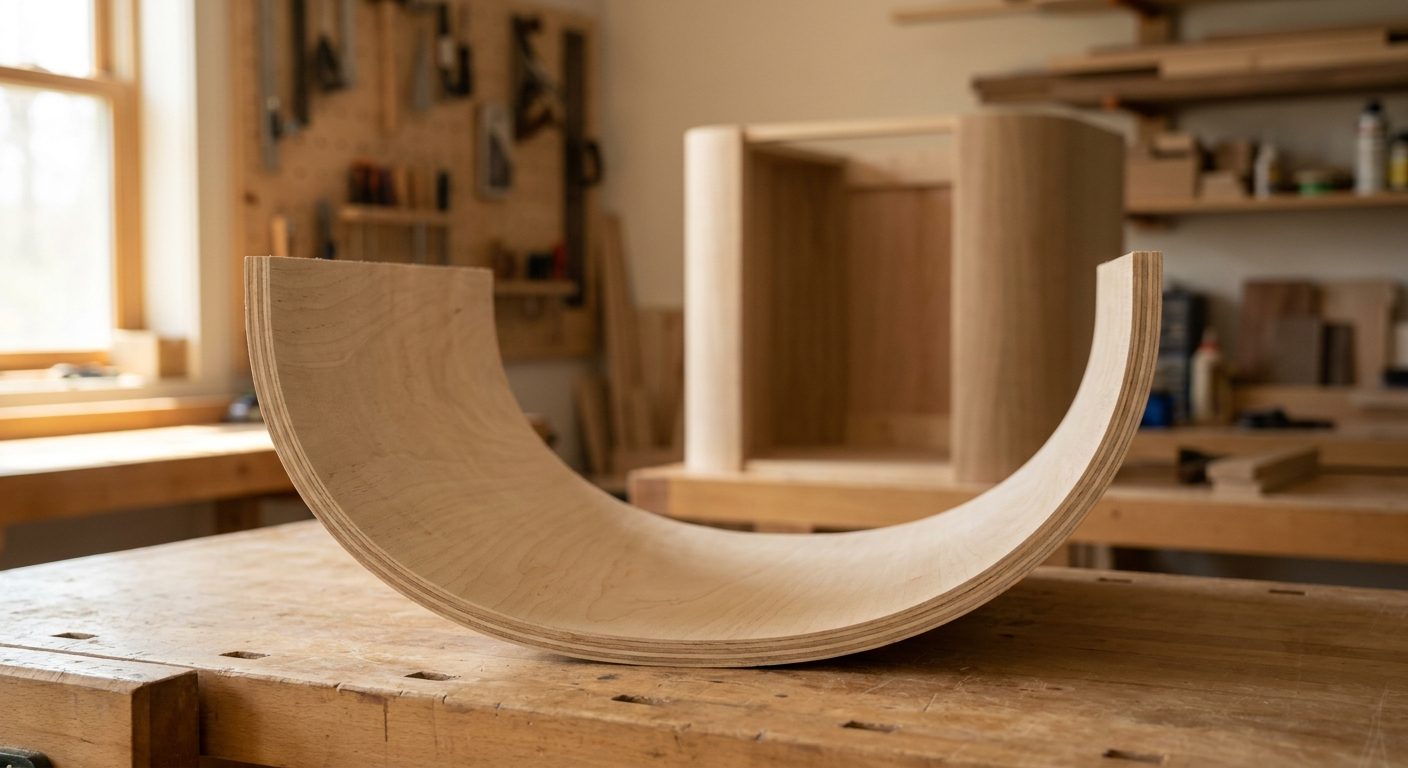
Bendable plywood curves. That is the point of it. Rounded reception desks, barrel-front cabinets, a wave ceiling, the swept wall in a shopfront, all of that leans on a thin interior sheet that wraps a radius by hand. Buyers in the US and Canada rarely call it bendable plywood at the counter, though. They ask for wiggle board. Some ask for wacky wood. Both are the same sheet the rest of the trade lists as flexible plywood, curve ply, or bending ply, and every one of those names is describing a panel that bends around a tight curve where ordinary construction plywood would simply crack.
The rest of this is the practical version. What it is, how tight it bends by thickness, how the sheet gets built, where it earns its keep on a job, and how it compares with the two other ways people make a curve. But read one line first, because it decides everything downstream: this is an interior, non-structural product. Not formwork. Not for the weather. It carries no load, and nothing further down walks that back.
What is bendable plywood?
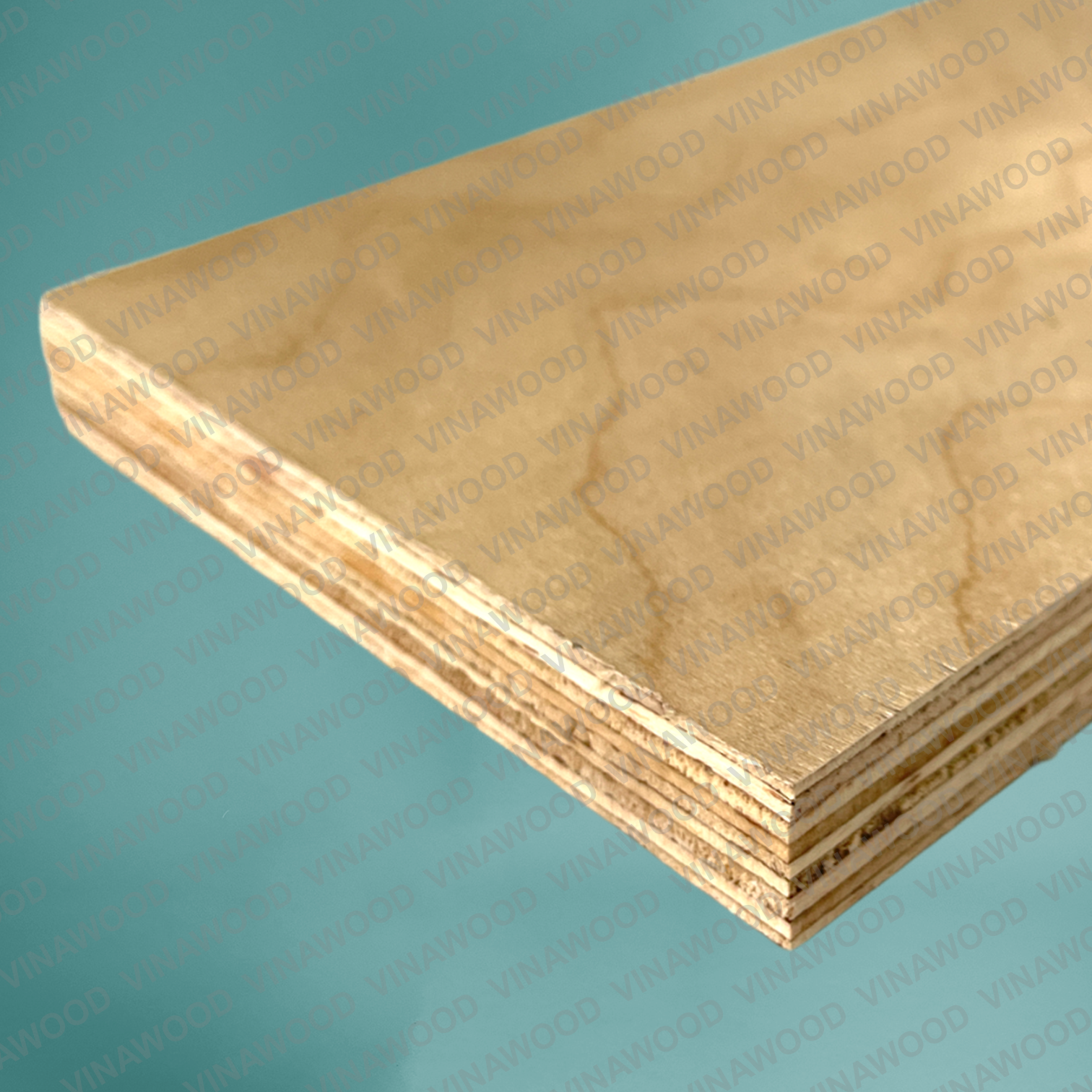
Take a normal sheet of plywood apart in your head. Each veneer sits at 90 degrees to the one beneath it, and that cross-banding is exactly what makes the board stiff whichever way you push. Bendable plywood throws that rule out. Its veneers mostly run the same way, so the sheet goes limp along one axis and you can pull it around a curve by hand.
You pay for that with rigidity. A bendable panel will not hold weight, and it was never meant to. What you get in exchange is a sheet that curves cold, no steam and no press, and then gets glued to a frame or skinned with a face veneer once the shape is set. That is the whole bargain.
Names vary by region and trade. Flexible plywood, curve ply, bending ply, and in North America wiggle board or wacky wood. Thicknesses usually land between 3 mm and 9 mm, roughly 1/8 in to 3/8 in. The core is normally a low-density plantation species, poplar or okoume most often.
Can it go outdoors?
No. The glue is interior-grade and the core is thin and soft, so this material lives inside. A curved element that will see damp air needs a sealed assembly over a moisture-resistant substrate, not raw bending ply doing the work. And treat any "water-resistant" line on the marketing with a raised eyebrow. These panels are not rated for wetting, and unless a specific data sheet says otherwise the bond is an interior glue class.
Wiggle board and wacky wood: the North American name
Walk into a supply house in the US or Canada and wiggle board is the phrase you will hear first. It is a trade nickname, nothing more, and wacky wood is the same nickname wearing a different hat. Both mean bendable plywood: a limp sheet that bends the easy way to form a curve.
There is one thing worth sorting out, because two products occasionally sit side by side on the same rack:
- Laminated flexible plywood is built to flex. The veneers all run one way, so the sheet itself bends. This is what most people picture when they say wiggle board.
- Kerf-cut board is an ordinary panel that somebody has weakened, running saw cuts (kerfs) across the back so it folds along those lines rather than because the material wants to.
If the finished face has to show and the curve has to read as smooth, the laminated sheet wins every time. Kerf-cutting is a one-off workshop dodge, and on a thin face those kerf lines have a habit of ghosting through later.
How bendable plywood is made
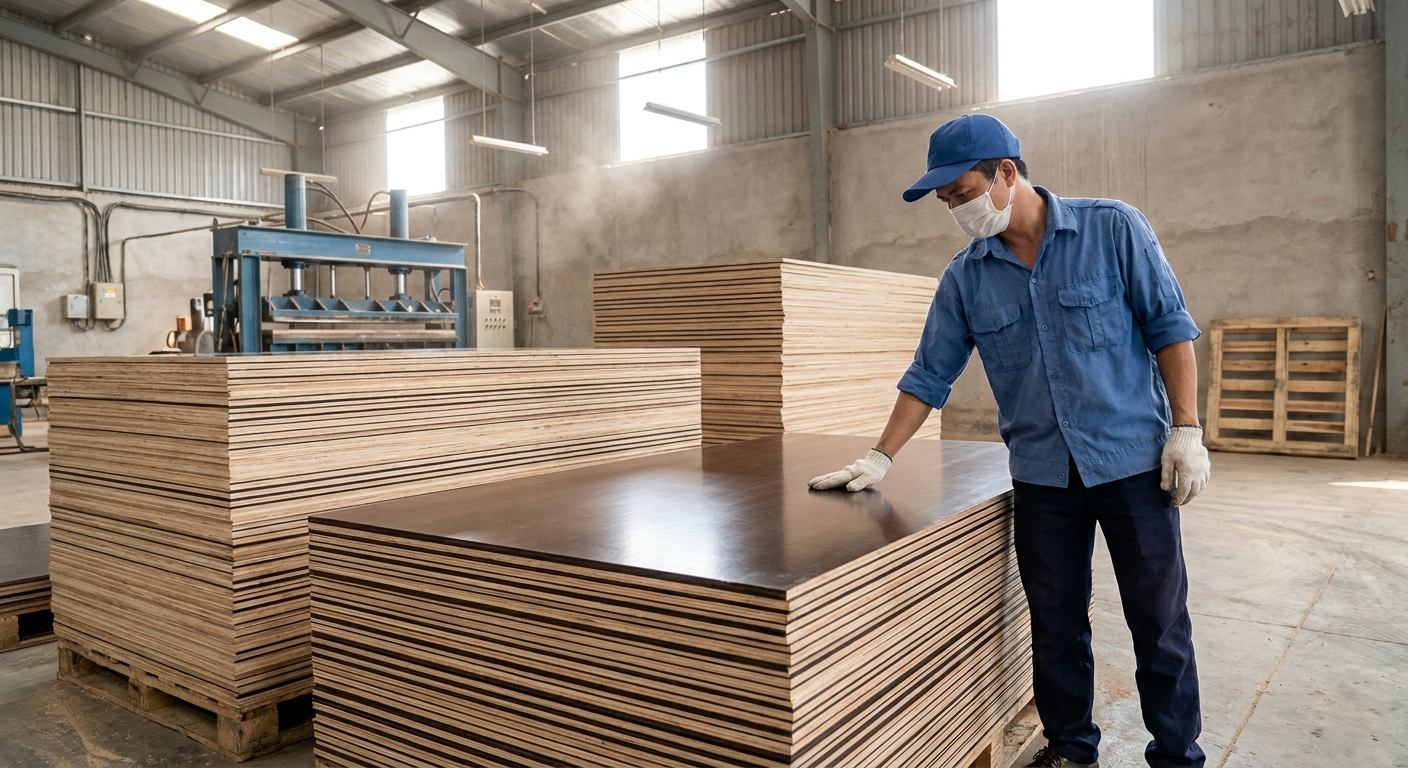
The build is almost boringly simple. Grain direction is the entire trick. You take thin veneers of a soft plantation species and stack them with the grain all pointing one way, instead of alternating it. A flexible glue holds the stack together and a press flattens it. Now every ply pulls the same direction, which leaves the sheet strong along the grain and weak across it. It bends around the weak axis. That is the trick, start to finish.
Compare that to a standard sheet, which cross-bands its veneers precisely to erase that weak axis and stay rigid both ways. Bendable ply keeps the weakness on purpose. A single face veneer sometimes goes on afterward for looks, but the core underneath stays parallel-grained.
- Pick uniform low-density veneers, poplar or okoume.
- Stack them one way, no cross-banding.
- Bond with a flexible interior glue and press flat.
- Add a face veneer if the job needs one.
Because it curves cold and quick, a fabricator reaches for it long before setting up a steam box or laminating a stack of thin strips over a former.
Minimum bend radius by thickness
Two things set how tight a sheet goes: how thick it is, and which way you bend it. The numbers below are starting points, not promises. Actual minimums drift with the maker, the core species, the moisture in the shop, and whether you are working over a former or freehand. Pull the supplier data sheet before you commit to a radius.
| Thickness | Easy direction (designed bend) | Cross direction |
|---|---|---|
| 3 mm (1/8 in) | ~150 mm (6 in) | ~450 mm (18 in) |
| 5 mm (3/16 in) | ~250 mm (10 in) | ~600 mm (24 in) |
| 7 mm (9/32 in) | ~350 mm (14 in) | ~900 mm (35 in) |
| 8 mm (5/16 in) | ~400 mm (16 in) | ~1000 mm (39 in) |
| 9 mm (3/8 in) | ~450 mm (18 in) | ~1100 mm (43 in) |
Two habits are worth keeping in your head. First, thinner bends tighter. Second, a sheet gives up its designed axis far more easily than the cross axis, and that is precisely why you name the grain direction, long grain or cross grain, when you place the order. Radius too tight for a single sheet? The old shop answer is to glue two thin sheets over a former and let the cured glue hold the curve.
You will also run into old spec sheets quoting a single number, 340 mm here, 110 mm there. Those are almost always different thicknesses bent in different directions. Slot them into the table above rather than reading any one of them as the truth for every panel.
Key benefits
The cold bend is the obvious win. No steam, no kerfing, none of the fiddly hand-laid strips. On a curved reception desk, or even a plain radius corner, that alone erases hours of shaping and the jigs shaping usually drags along with it. Weight is the quieter win. A low-density core leaves the sheet lighter than MDF or a hardwood panel of the same size, and you feel that difference the instant the work goes overhead or ends up hanging from a ceiling.
Finishing is friendly. Once the curve settles, the surface takes wood veneer, high-pressure laminate, or paint without a fuss, so it holds up for the visible curves in a hotel lobby or a shopfront. And it behaves under normal tools. Cut it, glue it, staple or nail it with what is already on the bench. It grips a fastener better than an MDF flexboard and it does not crumble at the edge when it is worked with any care.
There is a material-efficiency angle as well. A lot of bendable panels run on fast-growing plantation-grown hardwoods such as poplar or eucalyptus, and the high yield during shaping leaves fewer offcuts behind. Fit-outs chasing LEED credits notice that.
Applications
Wherever a design wants a curve and a flat panel simply will not bend to it, this is the sheet that shows up.
- Architectural interiors: curved feature walls, wave ceilings, and acoustic baffles in lobbies and halls, where a curved surface scatters sound and takes the hard edge off a room.
- Furniture and millwork: barrel cabinets, radius corners on reception counters and kitchen islands, curved-edge shelving, the molded back on a lounge chair.
- Retail and exhibition work: point-of-purchase displays, kiosks and trade-show booths with rounded corners, display pods thrown together on a short deadline.
- Transport and marine interiors: curved wall and ceiling linings in coaches, RVs, and boat cabins, where the twin problems are weight and a tight contour.
Bendable plywood vs MDF flexboard vs solid-wood bending
A curve does not have to come from bendable plywood. Two other routes show up often: MDF flexboard, which is a kerf-scored fibreboard, and old-fashioned solid-wood bending done with steam or laminated strips. Where they differ is weight, tooling, finish, and what actually costs you money.
| Bendable plywood | MDF flexboard | Solid-wood bending | |
|---|---|---|---|
| Weight | Light | Heavy | Medium to heavy |
| Tooling | Cold bend, no former for gentle curves | Cold bend, kerfs pre-cut | Steam box or laminating former |
| Finish | Takes veneer, laminate, or paint | Best for paint, kerf side hidden | Shows real timber grain |
| Cost driver | Panel price | Cheap panel, more filling and finishing | Labor and time |
| Best use | Smooth curves with a finished face | Painted curved substrates, hidden cores | Premium exposed solid timber |
For a smooth curve that has to show a wood or laminate face, bendable plywood usually lands in the practical middle. MDF flexboard is cheaper by the sheet but heavier, and it really wants paint over it. Solid-wood bending gets you real timber and charges you in labor for the privilege. If the panel-versus-panel question is what you are stuck on, our guide on MDF vs plywood works through strength, moisture, and finish.
Where bendable plywood fits alongside Vinawood's range
Here is the straight answer, since buyers put it to us plainly. Vinawood does not make bendable or flexible plywood. It is a specialist interior product and it sits outside what we manufacture. If a supplier claims a Vietnamese formwork mill is loading you wiggle board, stop and ask what is actually in the container.
From our side of the trade, most of the bendable-ply enquiries that reach us from North American fabricators turn out to be about the flat carcase hiding behind the curve, not the curve itself.
And that flat work is where we belong. A curved build is hardly ever all curve. The barrel-front reception desk still has flat sides, a base, and shelving. The wave wall still frames onto flat backing. Those parts are commercial and interior plywood, which is our range. Vinawood commercial plywood covers the furniture-grade and joinery panels for the flat work, cut and finished the way you would treat any cabinet-grade sheet.
So the split is clean. Buy a purpose-built flexible panel for the curve, and name its thickness and grain direction. For everything flat around it, Vinawood ships FSC-certified, ISO 9001, CARB P2 and EPA TSCA Title VI commercial plywood out of Vietnam to the United States, Canada, and 55+ countries. If it is the carcase you are speccing, our notes on furniture-grade plywood and plywood for cabinets go through grades and thickness.
Choosing and sourcing bendable plywood
Wiggle board, wacky wood, curve ply, whatever the label on the bin says, it does one job well. A clean, cold-formed curve on an interior, non-structural part. Match thickness and grain direction to the radius you are after, keep the thing indoors, and lay your veneer or laminate once the shape has settled.
The flat commercial and furniture-grade plywood that frames those curves is what Vinawood makes, direct in Vietnam. We have been at it since 1992 and export to 55+ countries, with FSC, ISO 9001, and CARB P2 / EPA TSCA Title VI certification on file. Ask us for a quote and the team will spec the panels for the flat parts of the build.
Category
how-to
Related Markets
Related Countries
Related Products
▶Sources & References (3)
- Italian Bending Poplar Plywood — Technical Data (minimum bend radius by thickness) — Columbia Forest Products (2023)
- Voluntary Product Standard PS 1-19 — Structural Plywood (grading reference) — APA — The Engineered Wood Association (2019)
- ANSI/HPVA HP-1 — American National Standard for Hardwood and Decorative Plywood (grading reference) — Hardwood Plywood & Veneer Association (2020)