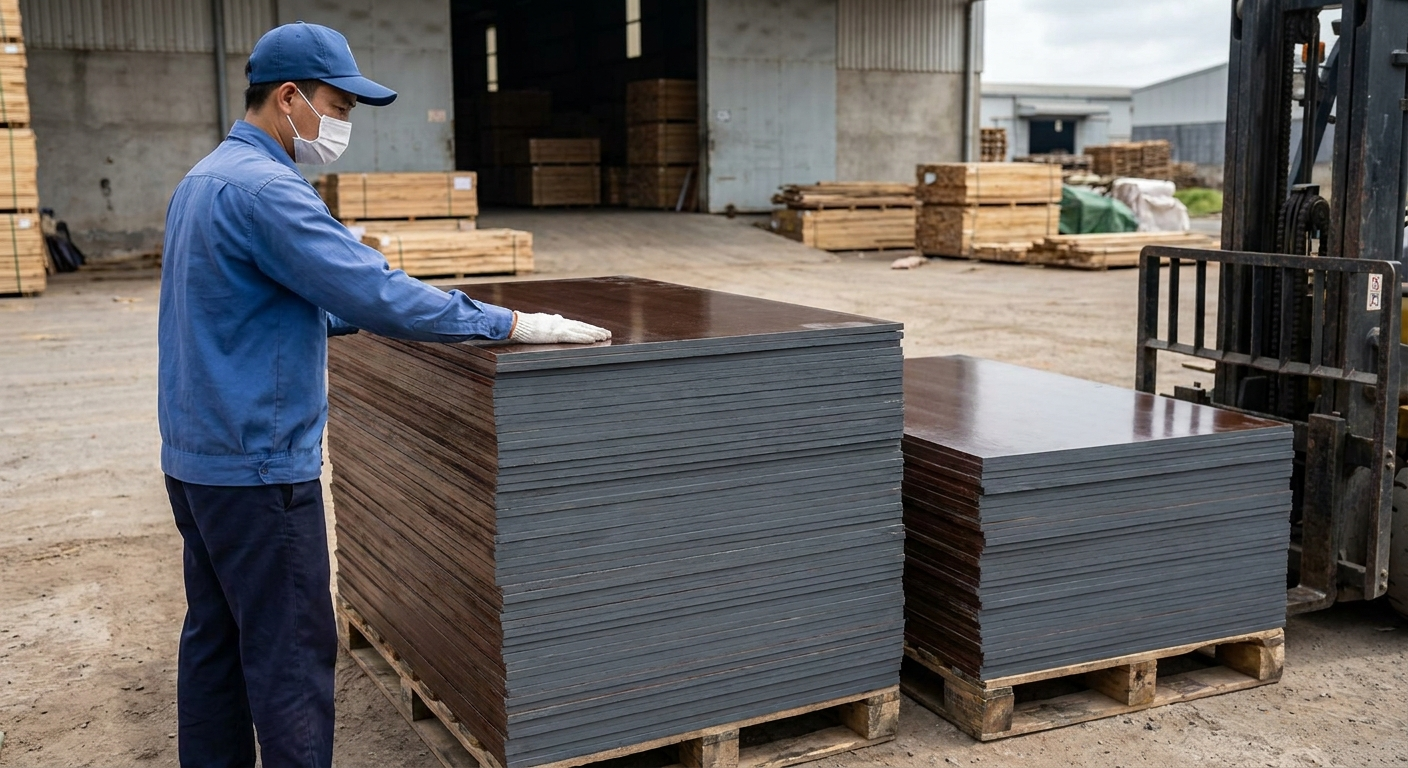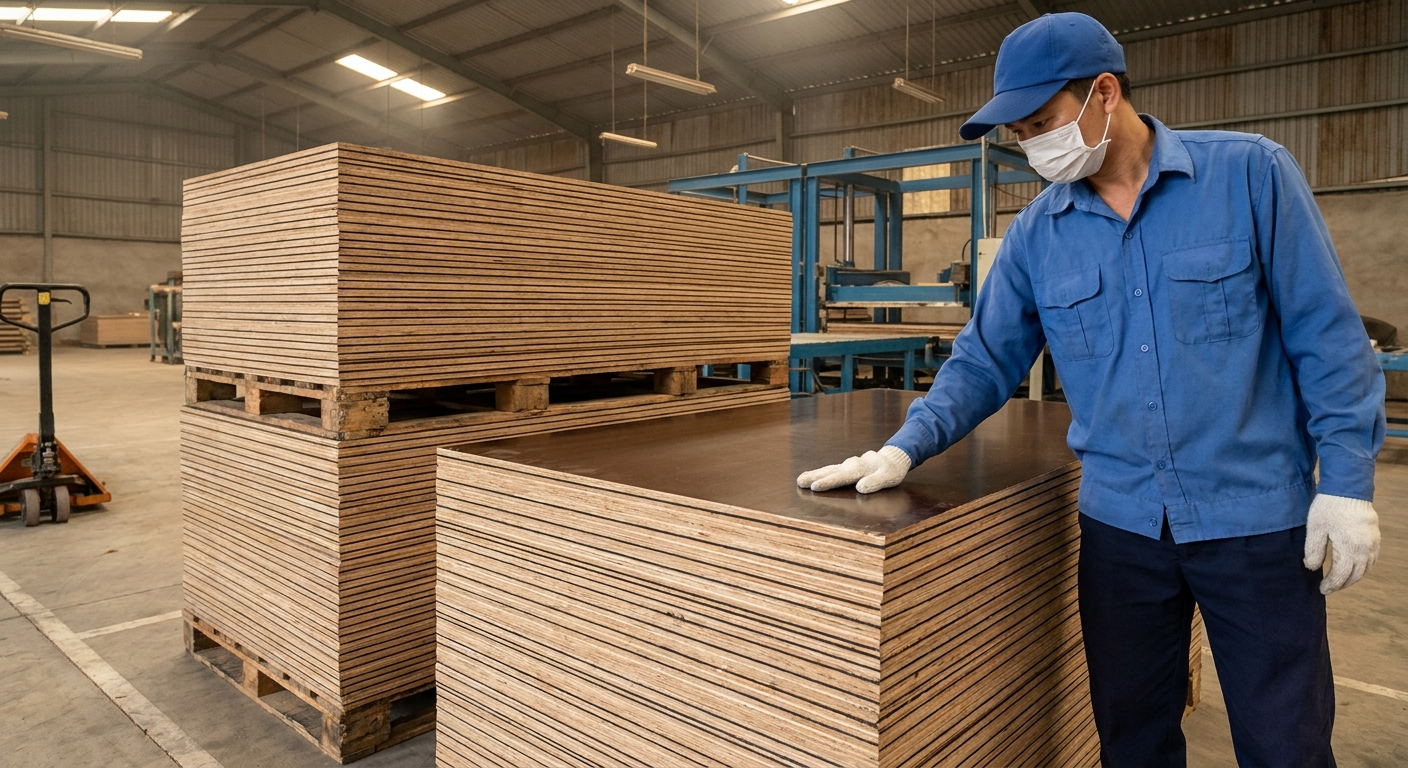
Plywood R-Value: Thermal Resistance by Thickness (and Why It's Not Insulation)
Plywood R-value runs about 1.25 per inch — 0.31 at 1/4", 0.94 at 3/4". The honest numbers, why plywood is sheathing rather than insulation, how it compares to OSB / solid wood / drywall, and where the R-value actually matters in a wall or roof assembly.
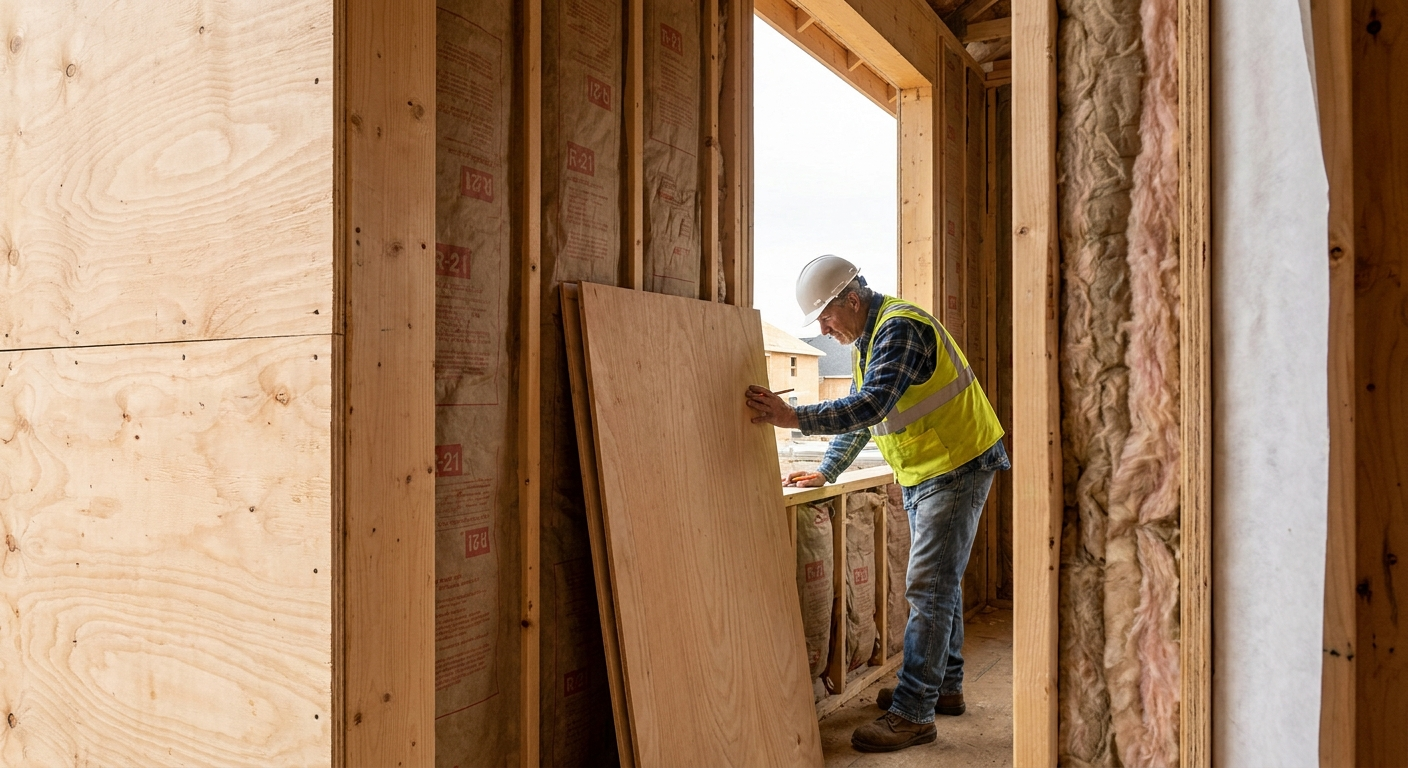
An R-21 2x6 wall pencils out around R-19 to R-20 once you account for thermal bridging through the studs. The 3/4" plywood sheathing contributes 0.94 of that. About 5 percent. The cavity insulation is doing the other 95.
That's the practical answer behind the question buyers actually mean when they ask what plywood's R-value is. The headline number is about 1.25 per inch. A 1/4" sheet sits near R-0.31; 1/2" near R-0.63; 3/4" near R-0.94; a full inch at R-1.25. The Alaska Housing Finance Corporation manual and the PFS-TECO tech tip have circulated those figures for years, and they match what Google's AI Overview pulls. Worth knowing. Worth qualifying the second the question goes beyond the number, because plywood is sheathing, not insulation.
What R-value actually is
One Fahrenheit degree of temperature difference per BTU per square foot per hour. That's R-1.0 per inch — the rate at which a material at that resistance value lets heat through. Higher number, slower flow. The units come from imperial building science, which is why North American product literature lists R rather than the metric thermal conductivity (k-value or lambda) European engineers use. The metric crossover sits further down for the EU and UK readers who land here from those SERPs.
One nuance buyers miss: R is additive across layers. A wall's total R is the sum of every layer in the stack, including the air films on each face. When plywood adds R-0.94 at 3/4", it adds 0.94 to whatever the cavity insulation, drywall, and sheathing membranes bring. The plywood doesn't replace insulation. It sits in series with it.
R-value of plywood by thickness
| Nominal thickness | Actual thickness | R-value (approx.) |
|---|---|---|
| 1/4" | 7/32" | 0.31 |
| 3/8" | 11/32" | 0.47 |
| 1/2" | 15/32" | 0.63 |
| 5/8" | 19/32" | 0.77 |
| 3/4" | 23/32" | 0.94 |
| 1" | 1" | 1.25 |
Real values shift with species: denser hardwood plies run a hair lower per inch than softwood. They shift with moisture content too — a wet sheet conducts heat faster than a dry one. And with manufacturing density. Use the table as a reference, not a guarantee for a specific panel. APA's Engineered Wood Construction Guide lists 1.25 R per inch as the working figure for design calculations.
Quick conversion for European specifiers: 1.25 R per inch corresponds to a thermal conductivity (k-value, lambda) around 0.12 W/(m·K) for plywood. EN ISO 10456 cites that band for solid wood and wood-based panels.
Plywood vs OSB
OSB runs a hair above plywood per inch. Typical R is 1.30 to 1.40 against plywood's 1.25. Density does it: OSB's compressed strand mat packs slightly higher mass per cubic foot than the cross-laminated veneer in plywood. The thermal difference is small enough that in a real wall it doesn't move the calculation. Choose between OSB and plywood on swelling behavior under repeated wetting, on nail-holding, and on edge integrity for cladding attachment. Thermal resistance is not the deciding factor between them.
Plywood vs solid wood and drywall
| Material | R per inch | Role in assembly |
|---|---|---|
| Plywood | ~1.25 | Structural sheathing |
| OSB | ~1.30–1.40 | Structural sheathing |
| Solid wood | ~1.00 | Framing |
| Drywall (gypsum) | ~0.45 | Interior finish |
| Fiberglass batt | ~3.1–3.7 | Cavity insulation |
| Mineral wool batt | ~3.7–4.3 | Cavity insulation |
| Closed-cell spray foam | ~6.5–7.0 | Cavity insulation |
| Polyiso continuous board | ~6.0–6.5 | Continuous exterior insulation |
Plywood beats drywall per inch, and barely beats solid wood. None of them is insulation. Insulation outperforms plywood by 3 to 5 times per inch, and the cavity carries 4 to 6 inches of insulation against the plywood's 3/4" on the wall face. Not close.
Plywood's real role in wall and roof thermal performance
Take a typical 2x6 wall on a US residential job. R-21 fiberglass batt in the cavity, 3/4" plywood sheathing on the exterior, 1/2" drywall on the interior, plus air film R-values on each face. The plywood contributes about 0.94 to a total assembly R of roughly 19 to 20 after accounting for thermal bridging through the studs. About 5 percent of the assembly. Doubling the plywood to 1.5" lifts the assembly by under one R-point, at a panel cost that buys nothing structurally.
Buyers occasionally ask whether thicker plywood helps with cold rooms or warm attics. It doesn't. Add insulation, fix air leaks, or specify continuous exterior insulation board over the sheathing. Plywood thickness should be chosen on span rating, nail-holding, and racking strength. Thermal performance is downstream.
The exception is exposed-sheathing assemblies where the plywood is the finished surface. Post-frame buildings. Barndominiums where a sheet of T1-11 plywood siding does the weather and aesthetic work. Cold-climate roof decking that gets a heavy ice-and-water membrane and roofing on top with no continuous insulation. In those cases the R-value still doesn't carry the assembly, but it counts more than on a conventional code-built wall.
Thermal conductivity (k-value) for engineers
European and UK specifiers reach for k (sometimes lambda) instead of R. The relationship is reciprocal — higher k means lower R. Plywood's typical k sits around 0.12 W/(m·K), which matches the EN ISO 10456 figure for cross-laminated softwood panels. An 18 mm panel comes in at about 0.15 m²·K/W thermal resistance. Metric equivalent of imperial R-0.85.
Species mix shifts this a little. Plantation hardwood plywood (eucalyptus, acacia, hevea) sits at slightly higher density than softwood plywood and runs a hair higher k, in the 0.13 to 0.14 W/(m·K) band. The thermal difference is too small to drive a panel-selection decision on its own. But it's the kind of detail an EN 14592-compliant declaration sheet will list for engineered timber components.
When plywood R-value actually matters
Post-frame metal buildings are the first case. Interior face is exposed plywood with no insulated cavity behind it; the R-0.94 is sometimes the only thermal layer between conditioned air and the outside, and the calculation has to be done honestly. Cold-climate roof decking under a thick ice-and-water membrane — where ice damming is the design constraint — is the second. The plywood adds modestly to the deck's thermal mass and slows heat transfer to the underside of the membrane. Vapor-barrier interaction is the third. Plywood's permeability shifts with moisture content, and a wet sheet conducts heat much faster than a dry one. We've seen buyers chase a low-R-value mystery for weeks when the underlying problem was a wetted-out sheathing layer that needed drying, not replacing.
Outside these niches, plywood's R-value is a footnote in the wall calculation. Worth knowing for completeness. Not worth optimizing for thermal performance.
About Vinawood
Vinawood manufactures film-faced concrete formwork and overlay plywood at our factory in Vietnam, with exports to more than 55 countries. The range covers EN 636-2 and EN 636-3 film-faced panels (Form Basic, Form Extra, Pro Form), the film-faced plywood collection, and overlay panels for North American forming use (HDO, MDO). We do not produce APA-stamped structural sheathing for permanent thermal-shell assemblies. For North American wall, roof, and subfloor sheathing in conditioned-shell applications, APA-stamped panels from domestic mills are the convention and the right product for that purpose. The R-value figures in this guide are the public reference numbers from APA, PFS-TECO, and the Alaska Housing Finance Corporation manual, cited here for buyer education and not as performance claims for Vinawood's product range. For questions about formwork or overlay specification, our technical team is reachable through vinawoodltd.com.
Category
guides
Related Markets
Related Countries
Related Products
▶Sources & References (4)
- Engineered Wood Construction Guide — APA — The Engineered Wood Association (2024)
- Tech Tip: R-Values of Wood Products — PFS-TECO (2023)
- Building Manual — Appendix 1, R-value tables — Alaska Housing Finance Corporation (2023)
- EN ISO 10456: Building materials and products — Hygrothermal properties — European Committee for Standardization (2007)