How Is Plywood Made? The 12-Step Manufacturing Process (From Log to Grade Stamp)
How plywood is made — the 12-step factory process from log selection through hot press to grade stamp. Plywood definition, veneer lay-up, glue classes (UF / MUF / phenolic), EN 314 vs PS 1, and the standards that govern bond performance in each export market.
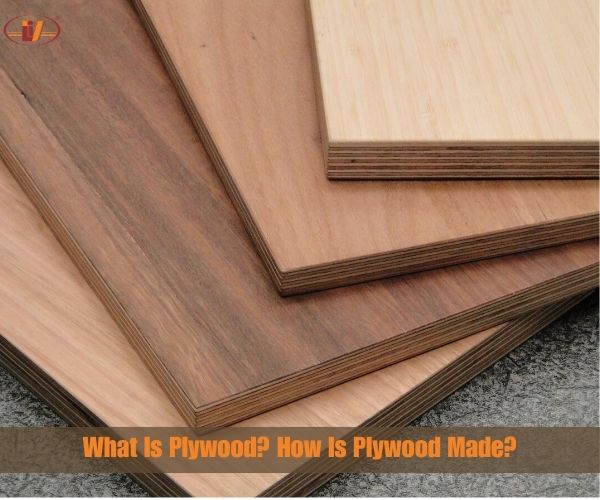
Plywood is made by peeling logs into thin wood veneers, drying them, then bonding the veneers in a cross-grain stack under heat and pressure until the stack becomes a single rigid panel. That is the whole idea in one sentence. Everything after it (species, glue chemistry, face overlay, grade stamp) is a variation layered onto the same core sequence.
At our factory the full pipeline runs as a 12-step controlled process, from grading the incoming log to loading the finished container. Here is the short version before the stage-by-stage detail:
- Log selection and peeling — graded logs are rotary-peeled into a continuous veneer ribbon.
- Veneer drying and storage — veneer is dried to 8–12% moisture, then conditioned before lay-up.
- Gluing and lay-up — adhesive is metered onto the core veneers and the cross-grain stack is assembled.
- Cold press — the stack is consolidated at ambient temperature to set the glue line.
- Hot press — heat and pressure cure the adhesive into one bonded board.
- Surfacing with putty — knots, splits, and open defects on the face veneers are filled.
- Sanding — panels are calibrated to target thickness and finish-sanded.
- Trimming — sheets are squared and cut to nominal size.
- Surface lamination — film-faced, MDO, and HDO grades get a film or overlay hot-pressed on.
- QC inspection — every panel is checked for bond strength, moisture, and dimension.
- Edge sealing — edges are sealed against moisture and the panel is marked for traceability.
- Packaging and shipping — approved panels are bundled, wrapped, and loaded for export.
We've run this line in Vietnam since 1992 and ship over 5,000 containers a year to buyers in 55+ countries. The walkthrough below is the same 12-step sequence a procurement manager sees touring our Kiên Giang factory, with the glues, standards, and grade stamps that decide where each panel is cleared to ship.
What plywood actually is
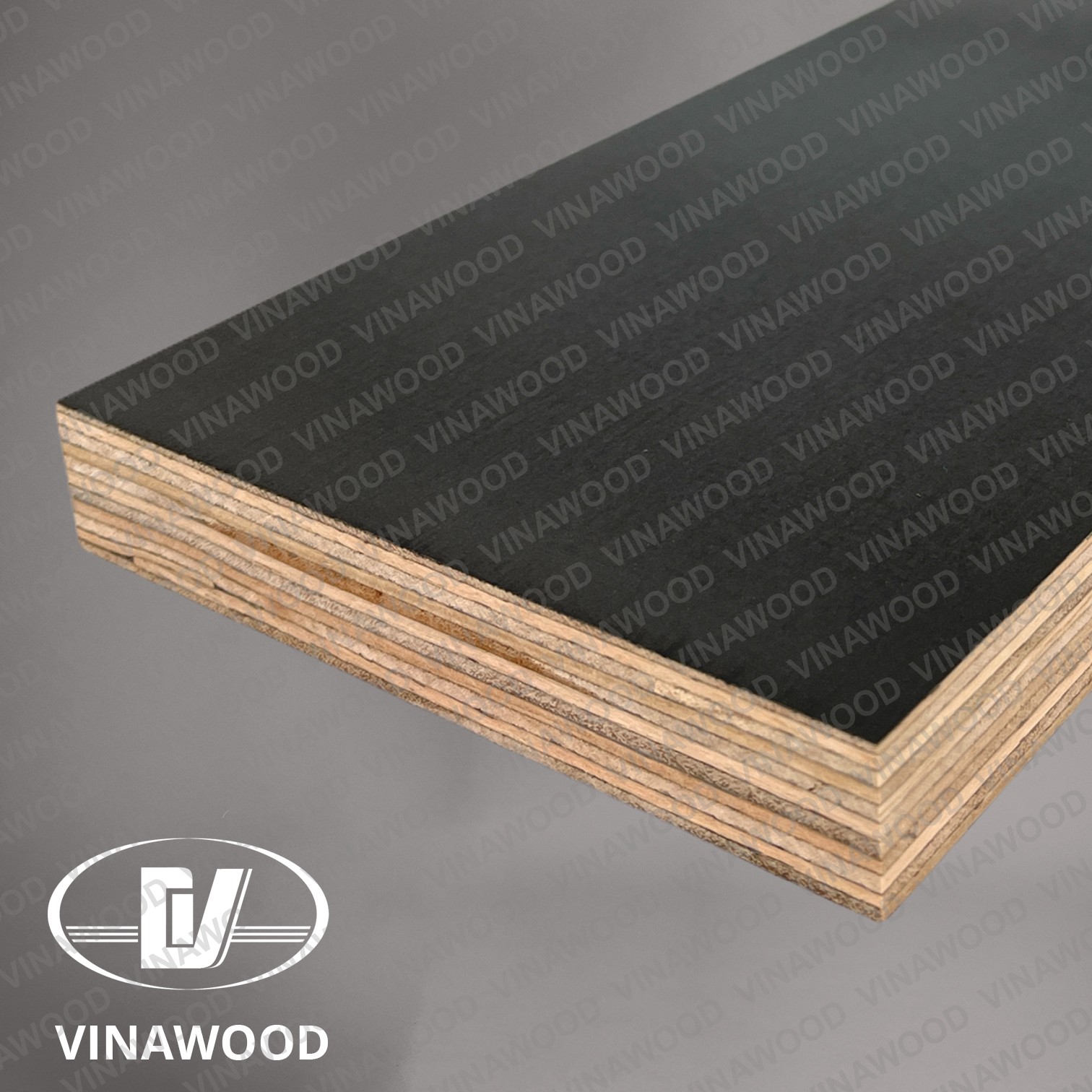
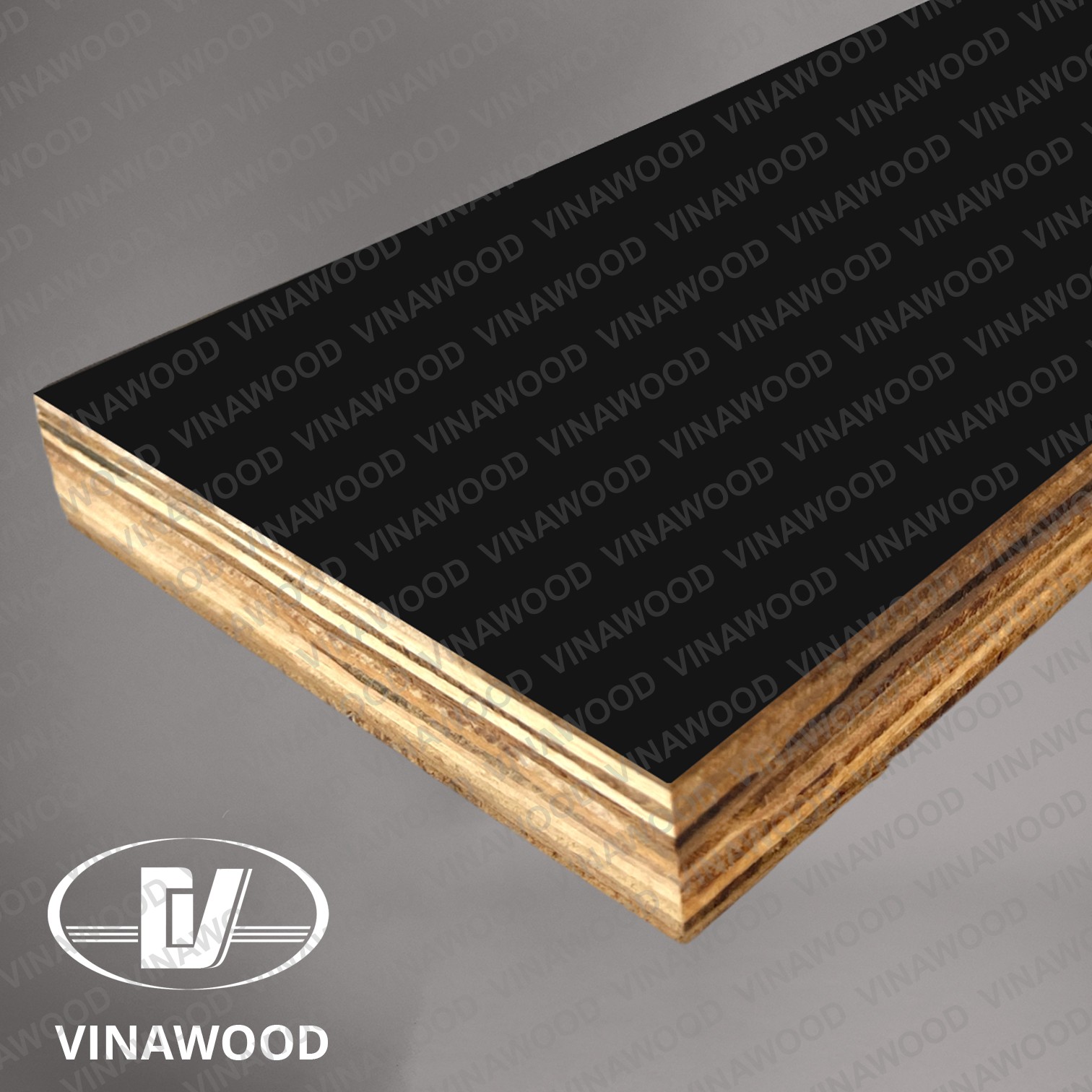
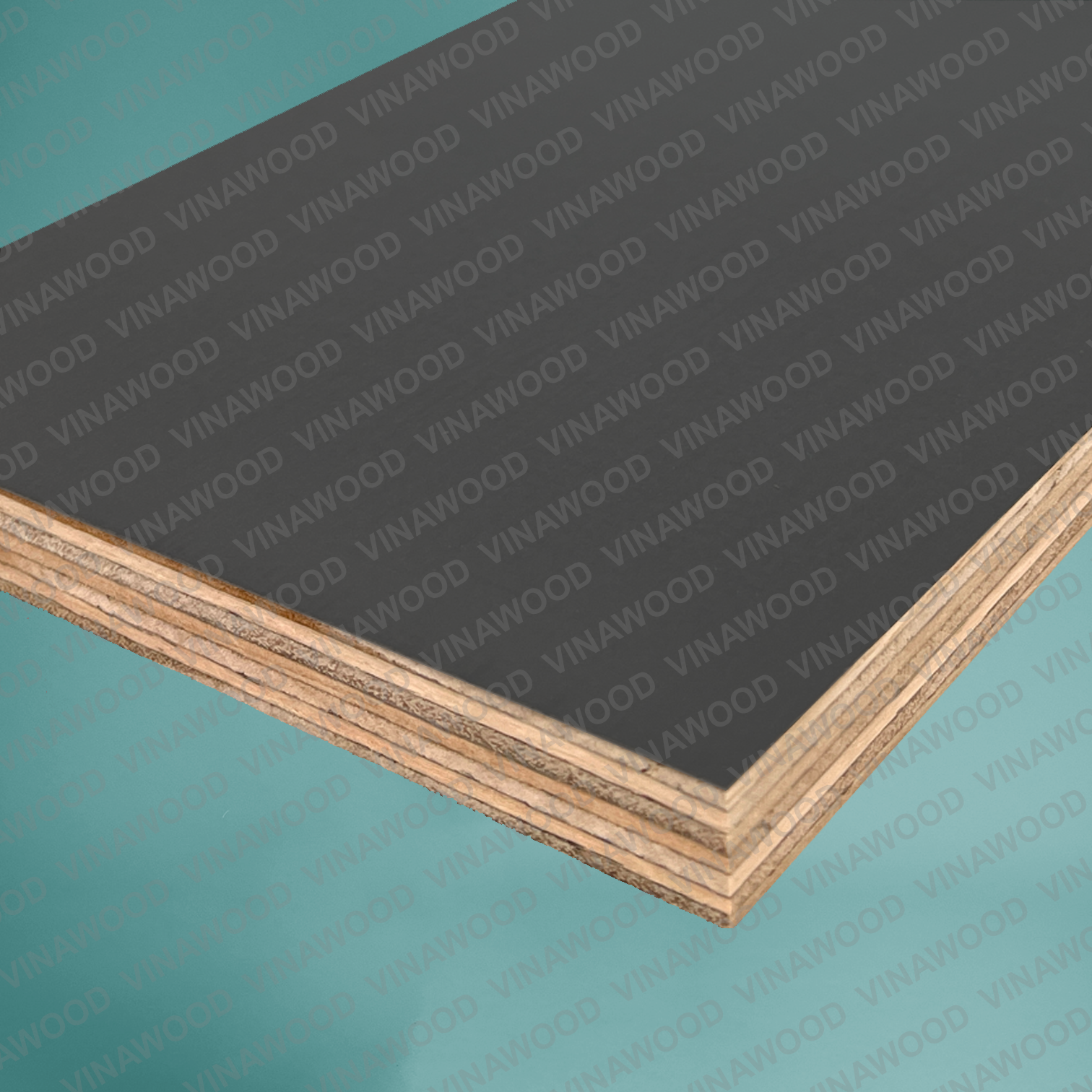
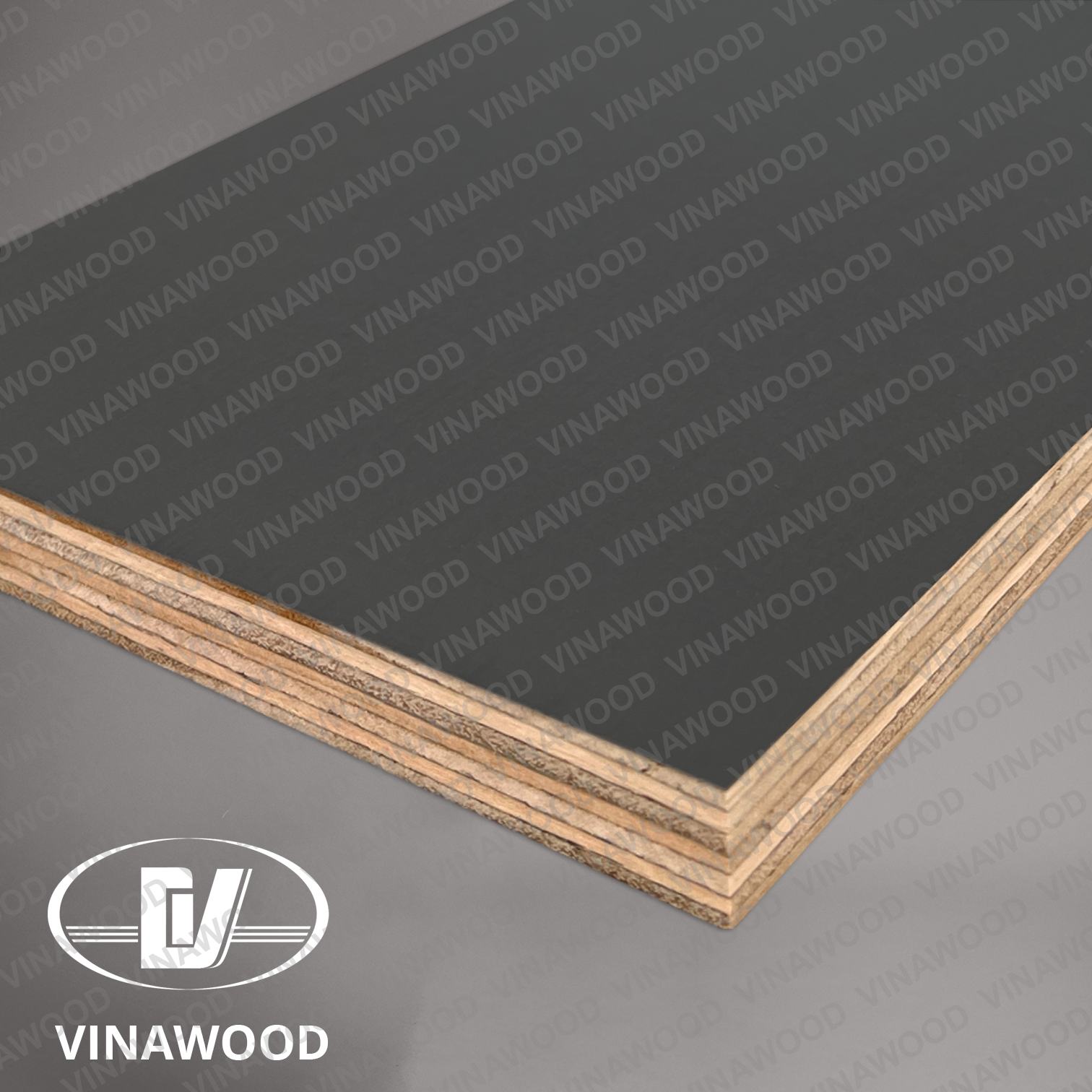
A plywood panel is a sandwich of veneer plies, always an odd number (3, 5, 7, 9, 11, 13), bonded with a thermosetting adhesive. The two face plies and every interior ply alternate grain direction by 90 degrees. That cross-banding is the point. Wood is strong along the grain and weak across it. Glue two veneers with their grains crossed and the composite behaves more isotropically than either layer alone. Add more plies and the panel resists warp, splitting, and impact better than a solid board of the same thickness.
The veneer can be hardwood (Acacia, Eucalyptus, Hevea, Birch) or softwood (Douglas fir, Southern pine). The adhesive can be urea-formaldehyde, melamine-urea-formaldehyde, or phenol-formaldehyde, each rated for a different exposure class. The pressing sequence (cold press, then hot press) consolidates the stack into a single rigid sheet. After pressing, panels are surfaced, sanded, trimmed, and graded against a national standard before the grade stamp goes on.
Plywood sits in the same engineered-wood family as oriented strand board (OSB), MDF, particle board, and blockboard. Each is a different way to turn a log into a sheet. Plywood keeps the wood as continuous veneer; OSB chips it into strands; MDF grinds it into fibre. The geometry of how the wood gets reassembled is what separates them at the lumberyard.
The 12-step plywood manufacturing process
The pipeline below is how Vinawood turns a log into a graded panel. The core sequence is universal across structural and formwork production; film-faced and overlay grades add the surface-lamination loop at step 9. Tighter mills add intermediate QC stations between stages, but the twelve steps are the backbone.
1. Log selection and peeling
Incoming hardwood and softwood logs are graded by species, diameter, straightness, and moisture before they reach the lathe. Hardwood logs (Acacia, Eucalyptus, Hevea) are usually hot-water conditioned first to soften the fibre and lift veneer yield. The conditioned log then spins against a knife on a rotary lathe, peeling a continuous veneer ribbon between 0.3 and 2.5 mm thick. Veneer thickness sets the ply count for the finished panel. Typical cycle: one to four minutes per log.
2. Veneer drying and storage
Wet veneer leaves the lathe at 40 to 80% moisture. The press needs it at 8 to 12% or the glue line fails. Jet-box and continuous roller dryers blow hot air across the sheets at 120 to 180 °C, while an optical scanner and clipper cut the ribbon into face-grade and core-grade sheets. Dried veneer is stacked and acclimatised on conditioning racks before lay-up. Drying runs 20 to 45 minutes per sheet depending on thickness and starting moisture.
3. Gluing and lay-up
Dried core veneers pass through a roller spreader that meters adhesive onto both faces; the show face stays unglued. The operator builds the stack in the target order (face, glued core, core, glued core, back), with each ply rotated 90 degrees against its neighbour. This is where cross-banding gets built in, and where the glue choice sets the panel's exposure class. Which glue does what is covered in its own section below.
4. Cold press
The assembled stack goes to a cold press first. Five to fifteen minutes at ambient temperature under moderate pressure consolidates the lay-up, drives out trapped air, and starts the glue's gel phase before the heat cycle. Cold pressing also keeps the plies from sliding when they hit the hot platens.
5. Hot press
The hot press is the heart of the mill. Steam-heated platens close on the stack at 120 to 150 °C and 10 to 14 kg/cm² for four to ten minutes. Heat drives the thermosetting glue to a full cure; pressure forces the veneers into intimate contact and removes glue-line voids. Press time scales with panel thickness and adhesive system. An 18 mm phenolic-bonded panel typically presses for seven to nine minutes.
6. Surfacing with putty
The cured panel comes off the press with small open defects on the face veneers: knots, splits, and minor voids. These are filled with wood putty at dedicated stations so the face reads uniform before it reaches the sander. Skip this and defects telegraph through a film face or a paint finish later.
7. Sanding
Wide-belt sanders calibrate the panel to target thickness within tolerance (typically ±0.3 mm for calibrated grade) and finish-sand the faces to the grit the end application needs. Calibration matters most for formwork and overlay grades, where an uneven substrate ruins the finished concrete face.
8. Trimming
Double-end trim saws square the panel and cut it to exact nominal size — 1220 × 2440 mm, 1250 × 2500 mm, or a custom dimension. Trimming takes about 30 seconds per panel and sets the final edge geometry buyers measure on arrival.
9. Surface lamination
Film-faced, melamine-overlay, MDO, and HDO products branch here. The finished sheet runs through a dedicated film or overlay press where a phenolic film, an MDO or HDO overlay, or another surface is hot-pressed onto one or both faces. Plain structural and commercial grades skip this loop and go straight to inspection. This is the step that turns a sanded panel into a concrete-forming or high-wear product.
10. QC inspection
Every panel is inspected for bond strength, moisture content, face defects, and dimensional accuracy against its target grade — 100% individual-sheet inspection, not batch sampling. Sample panels also go to the in-house lab for bond-shear testing per EN 314-2 (dry and after boiling) or PS 1 / PS 2 in the US system, plus MOR, MOE, and formaldehyde-emission checks.
11. Edge sealing
Approved panels get their edges sealed with water-resistant paint to slow moisture ingress at the most vulnerable point of any plywood sheet, the exposed end grain. Each panel is then printed with product and traceability marks, and the grade stamp that ties it back to a national standard.
12. Packaging and shipping
Panels are strapped into bundles, wrapped against weather, and loaded into 20 ft or 40 ft containers for sea or land freight. From graded log to loaded container, a panel spends only a few minutes at each station but roughly four to eight hours moving through the full line.
At-a-glance: plywood process flow
The same twelve stages, read as an input-to-output flow:
| Stage | Input | Action | Output |
|---|---|---|---|
| 1. Log selection & peeling | Graded hardwood / softwood logs | Condition, then rotary-peel against a knife | Continuous veneer ribbon (0.3–2.5 mm) |
| 2. Veneer drying & storage | Wet veneer (40–80% MC) | Dry, scan, clip, and acclimatise | Sorted veneer at 8–12% MC |
| 3. Gluing & lay-up | Dried veneer + adhesive | Meter glue, stack cross-grain, odd ply count | Assembled layup |
| 4. Cold press | Assembled lay-up | Consolidate at ambient pressure | Pre-set, air-free stack |
| 5. Hot press | Cold-pressed stack | Cure at 120–150 °C, 10–14 kg/cm² | Bonded rigid panel |
| 6. Surfacing with putty | Cured panel | Fill knots, splits, open defects | Uniform face |
| 7. Sanding | Puttied panel | Calibrate thickness, finish-sand | Panel at target thickness / grit |
| 8. Trimming | Sanded panel | Square and cut to nominal size | Dimensioned panel |
| 9. Surface lamination | Trimmed panel + film / overlay | Hot-press film or overlay (film-faced / MDO / HDO) | Overlaid panel |
| 10. QC inspection | Finished panel | Test bond, moisture, dimension (100%) | Graded, approved panel |
| 11. Edge sealing | Approved panel | Seal edges, print marks + grade stamp | Sealed, traceable panel |
| 12. Packaging & shipping | Bundled panels | Strap, wrap, load container | Export-ready shipment |
Which glue, which exposure class
The adhesive metered on at step 3 is the single most important spec on a plywood panel for any application that sees moisture. Confusing the bond class is the most common spec failure in the trade. Three glue chemistries cover the range:
- Urea-formaldehyde (UF). Interior only. Fails on prolonged wetting. Used for furniture-grade and decorative interior plywood. Bond class: EN 314 Class 1.
- Melamine-urea-formaldehyde (MUF), the melamine core resin. Weather-resistant. Survives short-term wetting and humid climates. Bonds Vinawood's Form Basic, Form Extra, Eco Form, and Consply formwork ranges, each with a phenolic face film over the MUF core. EN 314 Class 2 / EN 636-2.
- Phenol-formaldehyde (PF, also called WBP phenolic). Fully exterior. Survives boiling water and sustained outdoor exposure. Bonds Vinawood's Pro Form, HDO, and Marine ranges. EN 314 Class 3 / EN 636-3. APA-exterior grade in the US system.
A note on the word melamine: in a formwork context it almost always means the MUF core resin that bonds the veneers, not a decorative laminate and not a face film. Vinawood's MUF-bonded formwork panels are weatherable at EN 636-2, not interior-only. For the full breakdown, see our marine plywood reference and plywood markings guide.
Plywood standards and grade stamps
A plywood panel sold into a regulated market carries a grade stamp tying it back to a national standard. The stamp is what lets a building inspector, a procurement manager, or a customs officer verify what they're getting.
| Region | Standard | What it covers | Stamp signal |
|---|---|---|---|
| European Union | EN 13986 | Wood-based panels for construction (CE marking) | CE mark + EN 13986 reference |
| EU (bond class) | EN 314 / EN 636 | Bond quality and service class (1 dry, 2 humid, 3 exterior) | "Class 2" or "Class 3" on stamp |
| United States | PS 1-19 / PS 2-18 | Structural plywood (PS 1) and wood structural panels (PS 2) | APA trademark, span rating, exposure rating |
| UK | UKCA + BS EN 13986 | Post-Brexit conformity + EU standard | UKCA mark |
| India | IS:303, IS:710 | General plywood (IS:303) + marine plywood (IS:710) | BIS mark + IS reference |
| Korea | KS F 3101 | Construction plywood | KS mark |
From a Vietnamese mill perspective, the multi-standard regime is just the daily reality of export production. The same factory line produces panels stamped to EN 13986 for EU shipments, PS 1-19 for North American shipments, and BIS for Indian shipments — what changes is the test-cert package and the stamp, not the underlying construction. For deeper coverage of grade stamps and how to read them, see our plywood markings guide and plywood span rating reference.
What plywood is NOT — disambiguation
Three engineered panels frequently get confused with plywood at the retail counter. The construction is different enough that picking the wrong one ends in service failure.
OSB (Oriented Strand Board). Wood chipped into strands roughly 100 mm long, layered in alternating orientations, and bonded with phenolic resin under heat and pressure. Cheaper than plywood at the same thickness. Comparable in-plane strength when dry. Swells permanently at edges when wetted. Common in North American sheathing. See our OSB vs plywood comparison.
MDF (Medium Density Fibreboard). Wood ground to fibre, mixed with urea-formaldehyde resin, and hot-pressed. Smooth, paint-ready faces. No grain. Poor moisture tolerance. Useful for painted cabinet doors and decorative mouldings; never for structural or wet applications. See what is MDF.
Particle board. Wood chips and shavings bonded with UF resin. Lowest density of the engineered-wood family. Common in flat-pack furniture. Treat it as dry-zone-only unless specifically rated otherwise.
Blockboard. A solid softwood strip core (10 to 25 mm wide strips) sandwiched between thin veneer or plywood faces. Lighter than plywood at the same thickness, with better screw retention in the face but worse moisture performance through the cut edges. Used in lightweight dry-zone furniture.
Plywood differs from each of these because the wood stays as continuous veneer through every layer. That continuity carries load across the panel, across the cut edges, and across the screw lines in ways the chipped and ground alternatives cannot reliably match.
Plywood types by application
The 12-step manufacturing process is universal, but the species, glue, and grade choices vary by intended application. The main families:
- Structural plywood — Douglas fir, Southern pine, or hardwood core, phenolic glue, sheathing and roof-deck grades. PS 1-19 in the US, EN 636-2 or EN 636-3 in Europe.
- Formwork (concrete forming) plywood — phenolic film face on a hardwood plywood core. Vinawood's Form Basic and Form Extra (MUF core, EN 636-2), Pro Form (phenolic core, EN 636-3), and HDO range cover this category, with up to 20 reuse cycles on the phenolic-bonded panels. See our film-faced plywood collection.
- Marine plywood — phenolic glue throughout, denser hardwood core, no voids in inner plies, BS 1088 or IS:710 grade. For boat-building, dock work, and wet-zone cabinetry. See our marine plywood collection.
- Decorative plywood — selected face veneer (Birch, Oak, Cherry) on a commercial core, sanded and graded for finished appearance. Furniture and cabinet work.
- MDO and HDO plywood — medium- or high-density overlay laminated to a phenolic-bonded core. Concrete forming, with a matte finish for MDO and a glossy finish for HDO. See HDO vs MDO comparison.
- Birch plywood — denser, void-free constructions for demanding structural and aesthetic work. See Baltic birch plywood and birch plywood density and strength.
Knowing what plywood is made of clarifies why each variant exists. The choice of species sets density and screw retention; the choice of glue sets the moisture envelope; the choice of face grade sets the finish. None of the three is interchangeable.
Properties that follow from how plywood is made
Cross-grain lay-up, thermoset adhesive, and dimensional pressing combine to give plywood a property set that solid timber cannot match at the same thickness:
- Bidirectional strength. Plywood is strong along both axes. Solid timber is strong along the grain and weak across it.
- Dimensional stability. The cross-banded lay-up resists swelling, shrinking, and warp better than solid wood.
- Split resistance. Driving a screw through plywood does not split the panel along the grain the way a solid board does.
- Large sheet size. Standard 1220 × 2440 mm or 1250 × 2500 mm panels cover large areas with few joints.
- Predictable yield. Veneer thickness, ply count, and glue spread are controllable to a degree solid timber is not.
- Density-to-weight ratio. Hardwood-core plywood sits around 600 to 700 kg/m³, lighter than solid hardwood of equivalent strength.
For the deeper engineering data on density, MOE, MOR, and screw-holding, see properties of plywood and density of plywood.
About Vinawood
Vinawood is a Vietnamese plywood manufacturer established in 1992. We run the 12-step controlled process described above at our factories in Vietnam, with 100% individual-sheet inspection and in-house testing labs (MOR, MOE, bond strength, formaldehyde), producing over 5,000 containers a year for buyers in 55+ countries. The product range covers Form Basic and Form Extra (MUF-bonded EN 636-2 formwork), Pro Form (phenolic-bonded EN 636-3 formwork, up to 20 reuse cycles), the HDO range for high-rotation forming, and full commercial and marine grades.
Every panel ships with the compliance documentation buyers need: ISO 9001 quality management, FSC-COC and PEFC chain-of-custody, CE marking under EN 13986 for Europe, EPA TSCA Title VI / CARB P2 for the United States, KS mark for Korea, BIS for India, UKCA for the UK, and EPD for green building credits. The manufacturing pipeline, the standards we test against, and the documentation set are the same factory-direct package regardless of where the container lands. For a deeper look at material selection and end-use guidance, browse our film-faced plywood and marine plywood collections, or request a sample through the contact form.
Category
guides
Related Markets
Related Countries
Related Products
▶Sources & References (6)
- PS 1-19 Voluntary Product Standard — Structural Plywood — APA / U.S. Department of Commerce (2019)
- PS 2-18 Performance Standard for Wood Structural Panels — APA / U.S. Department of Commerce (2018)
- EN 13986:2004+A1:2015 — Wood-based panels for use in construction — European Committee for Standardization (CEN) (2015)
- EN 314-2:1993 — Plywood bonding quality — CEN (1993)
- Wood Handbook — Wood as an Engineering Material, Chapter 11 — USDA Forest Products Laboratory (2021)
- APA Trademark and Grade Stamp Guide — APA — The Engineered Wood Association (2024)