Best Plywood for Flooring & Subfloor: Grades, Thickness & Code
Which plywood to buy for a floor or subfloor: APA span-rated grades, thickness by joist spacing per IRC code, the CDX-versus-T&G call, an honest OSB comparison, and the install detail that decides whether the floor squeaks.
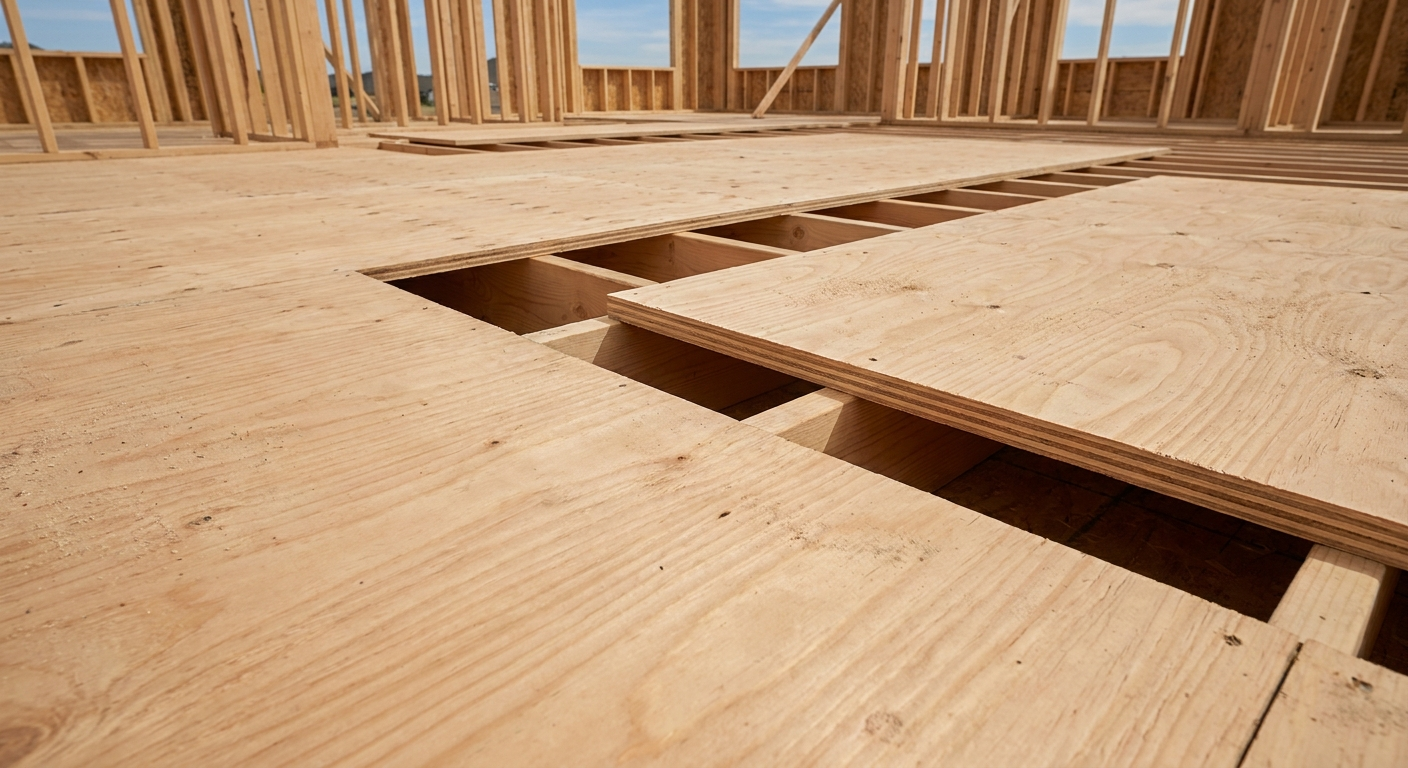
Most subfloor failures trace back to a panel that was wrong before it ever hit the joists. Either the thickness did not match the joist spacing, or someone substituted a non-rated sheet for span-rated stock, or the panel went down dry with no construction adhesive at the joist line. The plywood choice for a floor is not complicated, but it is unforgiving, and the cost of getting it wrong shows up three years later as a squeak underfoot or a soft spot in the hallway.
This guide answers the buyer's question directly: which grade to buy, what thickness for your joist spacing, when plywood beats OSB and when it does not, and how the install detail decides whether the floor stays quiet. It is written for residential builders, remodelers, and homeowners who want the spec right the first time, anchored to the IRC and APA references that a building inspector will actually check.
What "best" really means for a subfloor
A subfloor panel gets judged on three things, in order. Get the first one wrong and the other two cannot save the floor.
Structural rating. The panel has to be span-rated for the joist spacing it sits on. A span-rated panel carries an APA stamp that tells you the maximum support spacing it is designed for. This is the rating that lets the floor carry residential live loads without excessive deflection between joists.
Bond class. A subfloor sees construction-stage moisture before the building is dry-in. Rain on the framing, dew, a delayed roof. The minimum bond class for this is APA Exposure 1, which uses exterior glue and survives repeated wet-dry cycling during the build. Interior-glued panels are not appropriate for a subfloor at any thickness.
Underlayment compatibility. If a finish floor with its own underlayment will follow, the subfloor can be a simpler panel. If the plywood is the single structural layer that the finish floor fastens straight into, it needs a tongue-and-groove edge so the panel edges support each other between joists.
APA span rating decoded
The APA stamp on a span-rated panel looks cryptic until you know the fields. Reading left to right, it carries the panel grade (face and back veneer quality), the span rating, the bond classification (Exposure 1 or Exterior), the thickness, and the mill number. The span rating is the part that matters most for a floor.
The span rating shows as two numbers separated by a slash, for example 32/16. The first number is the maximum spacing in inches for roof sheathing; the second is the maximum spacing for subflooring. So a 32/16 panel is rated for subfloor on joists up to 16 inches on center. A single number followed by "oc" (such as 24 oc) appears on Sturd-I-Floor panels, which are single-layer combination subfloor-underlayment panels rated for that joist spacing.
Why the stamp matters: IRC section R503.2 requires wood structural panel subflooring to conform to the span ratings in the code's tables or to APA standards. An inspector checking a framed floor reads that stamp. A panel with no stamp, even if it looks identical, is not code-compliant subflooring. We hear from US contractors we ship to that the stamp is the first thing a plan reviewer asks about on a floor inspection.
The subfloor thickness table — by joist spacing
Thickness follows joist spacing. Wider spacing means the panel spans farther between supports and has to be thicker to keep deflection in check. The residential defaults:
| Joist spacing | Recommended subfloor thickness | Notes |
|---|---|---|
| 16" OC | 23/32" (3/4") T&G, 19/32" (5/8") minimum | The residential default for most floors |
| 19.2" OC | 23/32" (3/4") T&G | Common in engineered-joist layouts |
| 24" OC | 3/4" T&G minimum, 7/8" preferred | Step up for heavier live loads or tile finishes |
These thicknesses reference IRC R503.2.1.1 and the APA E30 span tables. They are sound rules of thumb for standard residential loading. They are not a substitute for structural design. When the load is non-standard, a heavy stone countertop run, a large aquarium, a commercial occupancy, the engineer or architect's spec overrides any table in a blog post. For how nominal panel thickness differs from the caliper reading at the yard, the plywood sheet sizes guide covers the nominal-versus-actual gap that catches buyers off guard.
CDX vs tongue-and-groove plywood for subflooring
CDX is a square-edge sheathing-grade plywood, Exposure 1, with a C-grade face and D-grade back. It is acceptable as a subfloor in two situations: when a separate underlayment will go over it before the finish floor, and when budget drives the build and the edges can be blocked or supported. CDX has no tongue-and-groove edge, so unsupported panel edges between joists will move under load unless you add edge blocking.
Tongue-and-groove plywood is the right answer for a single-layer subfloor that the finish floor fastens straight into. The T&G edge interlocks adjacent panels so the edges support each other without blocking, and the panel is glued and nailed (or screwed) to the joists. The result is a stiffer, quieter floor. The cost difference between CDX and T&G subfloor panels is real but small relative to the labor of adding edge blocking to a CDX floor.
OSB vs plywood for subfloor — the honest comparison
OSB has taken more than three-quarters of the US subfloor market, and it earned that share on cost. A sheet of OSB runs noticeably cheaper than an equivalent span-rated plywood panel, and for a dry, well-detailed floor it performs to the same span ratings. Pretending OSB is a poor product would not be honest.
Where plywood holds an edge is moisture cycling. When the framing gets rained on before dry-in, OSB swells at the cut edges and that swell does not fully recover when the panel dries. Plywood swells less and recovers more. Plywood also holds screws better at the edge, which matters for squeak-free fastening. For a build where the floor will be exposed to weather during framing, or in a wet climate where dry-in takes a while, plywood is the safer call. For a fast, covered build in a dry season, OSB at the correct span rating is a defensible choice.
The honest summary: the better panel depends on weather exposure during framing and on the joist spacing. Neither product is universally "best." Match the panel to the build conditions.
Plywood for finished plywood floors
Sometimes the plywood is the visible floor, not the layer under it. Plywood floors show up in garages, workshops, cottages, and the DIY plywood-floor look that has become popular in modern interiors. The spec shifts when the panel is the finish surface.
For a visible plywood floor, the face grade does the work: a B/C or A/C face for a paintable or stainable surface, or a hardwood and birch face where stain quality matters. Thickness stays at 3/4" for direct nailing to joists. The face you can see is what you pay for, so this is the one floor application where the appearance grade is worth the premium.
Plywood for wet-area subflooring
Bathrooms, mudrooms, and laundry rooms ask more of a subfloor. The panel here should be an exterior-rated grade, ACX or exterior-rated CDX, but the panel is not the waterproofing. The waterproofing is a membrane on top of the subfloor. Relying on the plywood alone to keep water out of the framing is the mistake that rots wet-area floors.
Three failure modes recur in wet areas. Water wicks into unsealed cut edges and swells the inner plies. The floor lacks slope to the drain, so water stands. The membrane is missing or discontinuous at the wall-to-floor transition. For the membrane-and-mortar sequence that prevents all three, the shower-pan installation guide walks the assembly step by step.
Construction sequence — installing plywood subfloor right
The panel choice gets you a sound floor only if the install is right. The sequence that decides whether the subfloor squeaks in three years:
- Prep the joists. Tops level and clean, no proud fasteners, no debris on the bearing surface.
- Glue every joist. A bead of construction adhesive on each joist before the panel goes down is the single biggest squeak-prevention step. The glue bonds the panel to the joist so the two move as one.
- Leave expansion gaps. A 1/8" gap at panel ends and edges lets the panel expand with humidity without buckling. T&G edges self-gap on the long side; the short ends still need the gap.
- Align the tongue-and-groove. Seat the T&G joint fully, tapping with a block so you do not damage the tongue.
- Fasten correctly. Screws every 6 inches around the perimeter and every 12 inches in the field. Screws over nails for a floor that has to stay quiet, because nails back out under cyclic load.
From the manufacturing side, we see the same pattern in field reports: floors that get glue on every joist and screws at the right spacing stay quiet for decades, while floors fastened fast and dry start talking within a few heating seasons.
Plywood for vehicle and trailer floors
A trailer or truck-bed floor is a different application with a different spec, even though it is still "plywood for a floor." Trailer decks see point loads from forklift tires, road spray from underneath, and constant chassis flex that a building floor never sees. The right answer there is a dense hardwood ply or an anti-slip film-faced panel at 3/4", not residential subfloor stock. The full breakdown lives in the plywood for trailer floors guide.
The cross-reference matters because buyers searching "best plywood for floors" sometimes mean a trailer deck and end up with a residential subfloor spec that will not survive the duty. Match the panel to the actual floor.
Failure modes to avoid
Three errors account for most subfloor problems, and all three are decided before or during install:
- Wrong thickness for the joist spacing. A 5/8" panel on 24" centers deflects between joists and the finish floor feels it. Match thickness to spacing per the table above.
- Non-rated panel substituted for span-rated stock. A sheet that looks like subfloor but carries no APA span rating is not code-compliant and may not carry the load. Read the stamp.
- No construction adhesive at the joist interface. The most common cause of squeaks. Glue is cheap; pulling up a finished floor to chase a squeak is not.
At-a-glance — quick selection
| Use case | Recommended spec |
|---|---|
| Standard residential subfloor, 16" OC | 23/32" (3/4") T&G, span-rated, Exposure 1, glued and screwed |
| Subfloor on 24" OC joists | 3/4" T&G minimum, 7/8" for tile or heavy loads |
| Budget subfloor with underlayment to follow | CDX, Exposure 1, span-rated, edges blocked |
| Visible plywood finish floor | 3/4" with A/C or hardwood/birch face for stain |
| Wet-area subfloor (bath, laundry) | Exterior-rated panel plus a waterproof membrane on top |
| Trailer or truck-bed deck | 3/4" dense hardwood ply or anti-slip film-faced |
For the broader formwork and forming-panel side of the plywood family, which sits adjacent to these structural questions, the concrete form plywood guide covers the overlay grades used in construction.
About Vinawood
Vinawood is a Vietnamese plywood manufacturer founded in 1992, exporting more than 5,000 containers a year to 55+ countries. Certifications include EPA TSCA Title VI / CARB Phase 2, CE marking under EN 13986, FSC chain-of-custody, and ISO 9001. For permanent structural subfloor work in the United States, APA-stamped domestic panels are the convention, and that is the honest recommendation for code-governed residential floors. Vinawood's role in the North American market is factory-direct phenolic and film-faced panels for concrete formwork, plus the complementary HDO plywood range and marine and birch-face grades for non-structural and specialty floor applications such as trailer decks and visible plywood floors. Technical data sheets and CARB compliance documentation are available at vinawoodltd.com.
Category
guides
Related Markets
Related Countries
Related Products
▶Sources & References (4)
- IRC 2021 Section R503.2 — Wood Structural Panel Subflooring — International Code Council (2021)
- APA E30 — Engineered Wood Construction Guide (span tables) — APA — The Engineered Wood Association (2024)
- APA / Voluntary Product Standard PS 1-19 — Structural Plywood — APA — The Engineered Wood Association (2019)
- APA — Subfloor Installation Best Practices — APA — The Engineered Wood Association (2023)