Plywood Wall Sheathing: Thickness, Code Requirements & Best Practices for 2026
Plywood wall sheathing in 2026 is a code-driven choice with regional variation. This guide covers IRC code-minimum thickness by stud spacing, the CDX vs structural plywood vs OSB comparison, hurricane-zone specifications, APA grade-stamp reading, and US retail pricing for buyers and contractors…
Last spring an inspector walked a half-finished house in Wilmington, NC and red-tagged the entire west wall. The framers had used 7/16" OSB on 24" o.c. studs, two weeks of coastal rain had hit the panels before the WRB went on, and the edge swell was permanent. The cure was peeling the OSB and re-sheathing in 19/32" plywood. Three days lost, nine sheets in the dumpster, and a coffee meeting where someone explained why the original spec had not survived contact with the schedule.
Plywood and OSB both pass code in most US wall-sheathing applications. The difference shows up at moments like that one — when the panel sits exposed longer than it should, or when the cladding pulls cyclically, or when the engineered shear-wall design demands a specific PS-rated panel. Those are the conversations this guide is built around.
The 2026 picture for plywood wall sheathing in US and Canadian residential construction breaks down into four practical questions: how thick by stud spacing, plywood or OSB, what grade for what wind zone, and how to read the APA stamp. Written from a manufacturer's perspective by Vinawood, a Vietnamese plywood mill exporting to North American buyers among 55+ markets globally.
What Plywood Wall Sheathing Actually Does
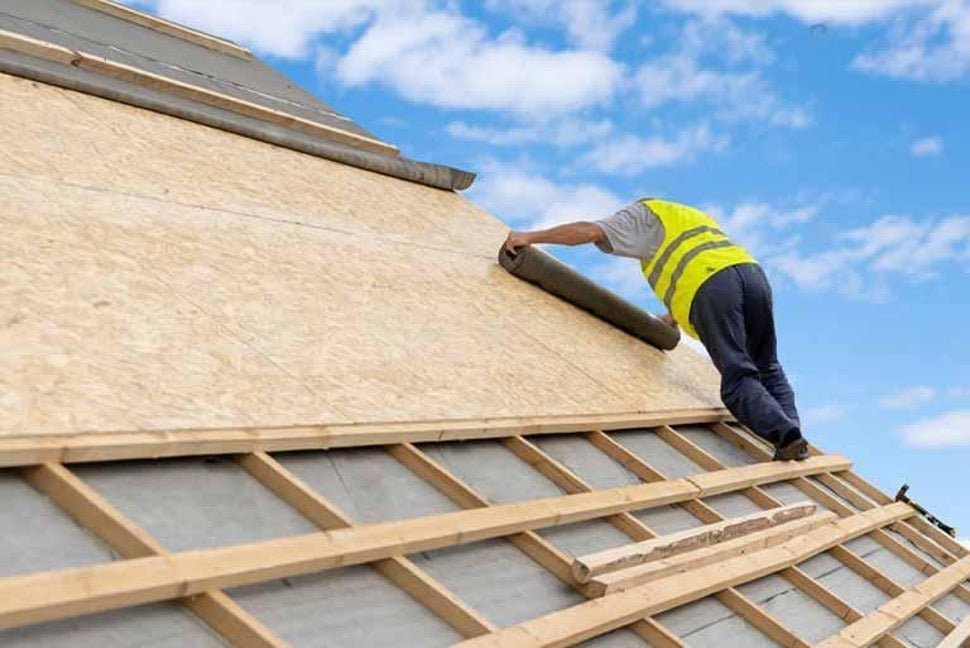
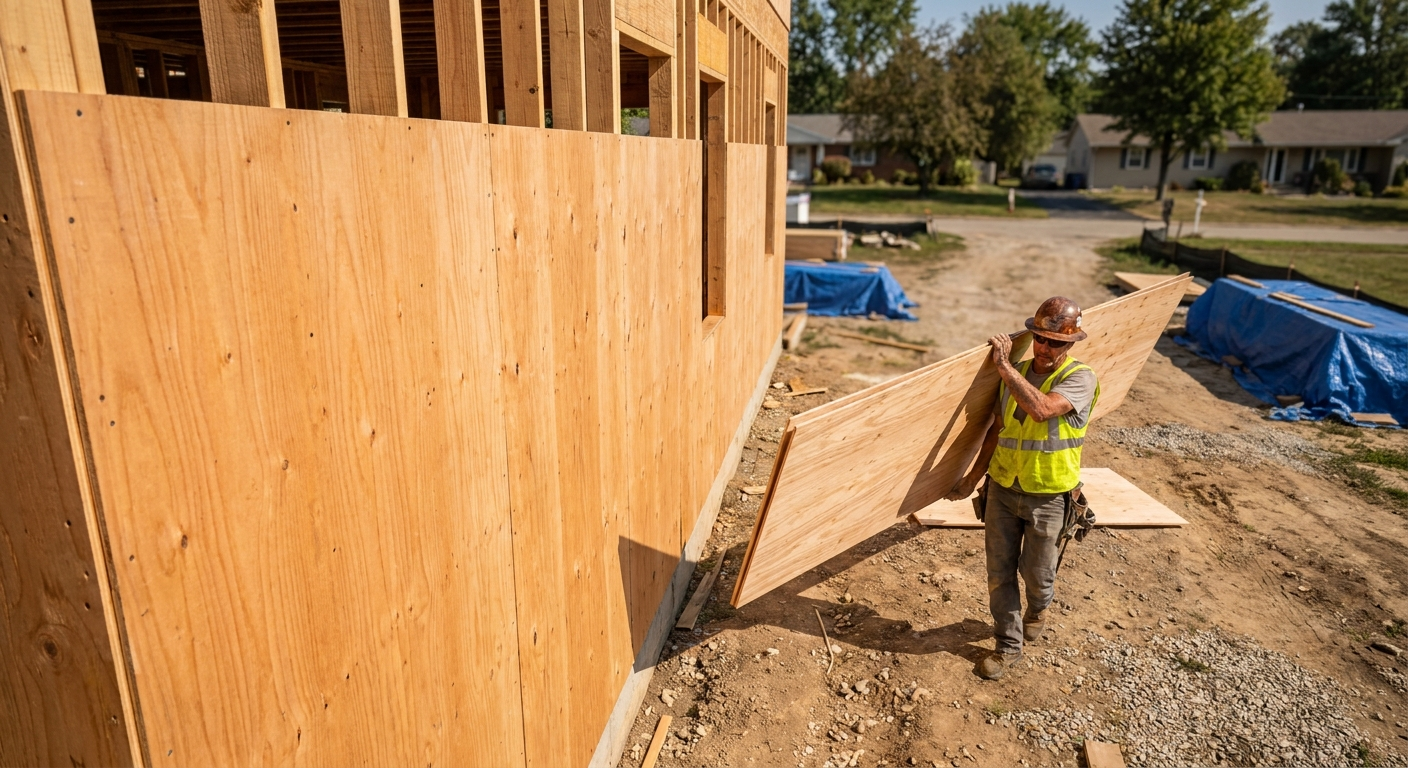
Plywood wall sheathing is structural plywood applied to the exterior face of wood-framed walls under siding or cladding. Functionally it does four jobs at once: it ties the studs into a shear-resistant diaphragm so the wall resists wind and seismic racking, it gives siding fasteners something dependable to bite into, it provides the continuous flat surface the WRB or house wrap needs to lap and seal correctly, and in walls running exterior continuous insulation it carries the structural plane while the foam handles thermal performance. Most cladding failures and most weather-related sheathing complaints trace back to one of those four functions getting compromised at install.
Plywood vs OSB for Wall Sheathing
The honest comparison — OSB is a legitimate sheathing material, and Vinawood does not manufacture OSB. The trade-offs:
Cost. OSB typically runs 10–20% cheaper than equivalent CDX plywood at the same nominal thickness. For production housing with tight margins, OSB is the budget-driven default.
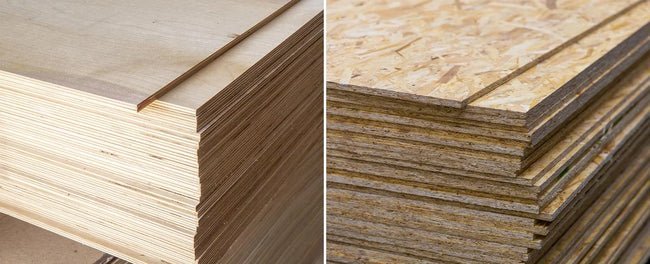
Shear strength. OSB and structural plywood are roughly equivalent in shear when both meet PS 2 or APA-rated structural designations. OSB sometimes tests slightly stronger in laboratory shear; plywood holds an advantage in cyclical-load fatigue.
Moisture behaviour. The largest practical difference. Plywood absorbs moisture, swells slightly, and recovers most of its original thickness when it dries. OSB absorbs moisture, swells more, and does not recover — the swollen edge is permanent and progressively reduces nail-holding strength along that edge. For coastal climates, high-humidity regions, and any project where the sheathing will be exposed to weather for more than a few days before drying-in, plywood is meaningfully better.
Nail-holding under repeated load. Plywood holds fasteners better than OSB under cyclical loads, particularly important for siding and trim that experience thermal expansion cycles. OSB nail withdrawal strength can be 20–30% lower at equivalent edge distance.
Weight. Plywood is roughly 5–10% lighter at equivalent thickness, marginal but noticeable on full-day framing crews handling 50+ sheets.
The practical recommendation: OSB is the budget default for production residential and dry-climate inland builds; plywood is the moisture-tolerant upgrade for coastal builds, high-humidity climates, custom homes, and any project where the sheathing may sit exposed before the cladding goes on. For the broader OSB-vs-plywood comparison, see Vinawood's OSB vs plywood guide.
Code-Required Thickness — IRC 2024 / IBC 2024
Plywood wall sheathing thickness in the US is governed by the International Residential Code (IRC) for residential and the International Building Code (IBC) for commercial, plus state and local amendments. The 2024 editions carry forward the prior thickness tables with refinements. Code-minimum and practical-default thicknesses by stud spacing:
| Stud Spacing | Code Minimum | Practical Default | Shear Wall / Braced Wall |
|---|---|---|---|
| 16" o.c. | 5/16" (3/8" for nail base) | 15/32" | 15/32" minimum, often 19/32" |
| 24" o.c. | 7/16" | 15/32" or 19/32" | 19/32" or 23/32" |
| Hurricane wind zones | 15/32" | 19/32" | 19/32" or 23/32" structural plywood |
This table is a guidance summary, not a substitute for the actual code. Local amendments — particularly Florida's HVHZ (High Velocity Hurricane Zone), coastal North and South Carolina, Texas Gulf Coast, and Louisiana's hurricane wind regions — carry stricter overlay requirements that supersede IRC defaults. Always verify the specific specification with the project's local building official and any engineered shear-wall calculations.
For the broader thickness reference, see Vinawood's 3/4" plywood explained (covering 23/32" structural sheathing) and actual size of 1/2" plywood (covering 15/32" CDX).
Quick Reference — the One-Paragraph Answer for Specifiers
15/32" CDX is what most US residential walls take, on 16-inch studs, R602-compliant. Wider studs or shear walls, go to 19/32". Florida HVHZ and the coastal Carolinas? 19/32" or 23/32" structural plywood with ring-shank fasteners under the wind amendment. The plywood-over-OSB cost premium runs 10 to 20 percent. Worth it the first time a coastal-build crew hits a two-week rain delay before the cladding lands. Plywood swells, dries back to roughly itself. OSB swells, stays that way. Always verify the specific specification with the project's local building official, the engineer of record where one is involved, and any local high-wind or seismic amendments to the IRC.
Category
guides
Related Markets
Related Countries
Related Products
▶Sources & References (7)
- International Residential Code (IRC) 2024 — Section R602 Wood Wall Framing — International Code Council (2024)
- International Building Code (IBC) 2024 — International Code Council (2024)
- APA Form L870 — Engineered Wood Construction Guide — APA — The Engineered Wood Association (2024)
- PS 1-19 — Structural Plywood — U.S. Department of Commerce / APA (2019)
- PS 2-18 — Performance Standard for Wood Structural Panels — U.S. Department of Commerce / APA (2018)
- ASCE 7-22 — Minimum Design Loads and Associated Criteria for Buildings — American Society of Civil Engineers (2022)
- Building America Solution Center — Structural Sheathing — Pacific Northwest National Laboratory / U.S. Dept of Energy (2024)