Walnut Plywood: Benefits, Uses, Cost & Where to Buy
In the realm of woodworking, walnut plywood stands as a testament to both elegance and resilience. Its rich, dark color, captivating grain patterns, and inherent strength make it a coveted material for crafting exquisite furniture, cabinetry, and architectural accents that exude timeless…
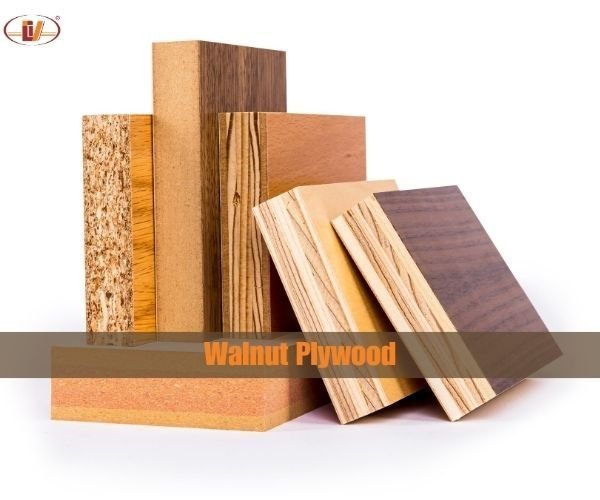
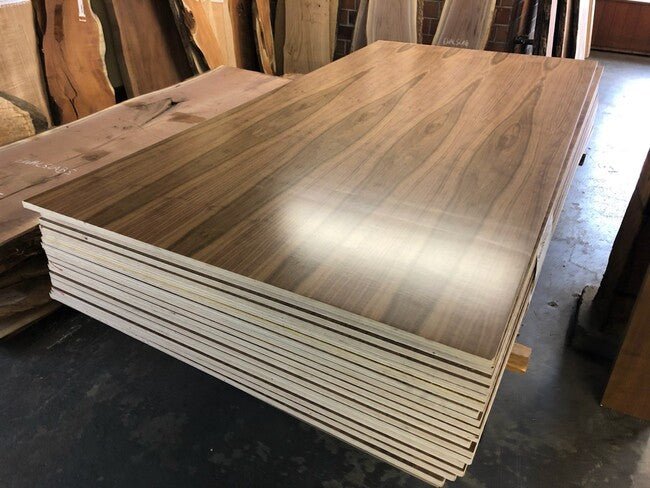
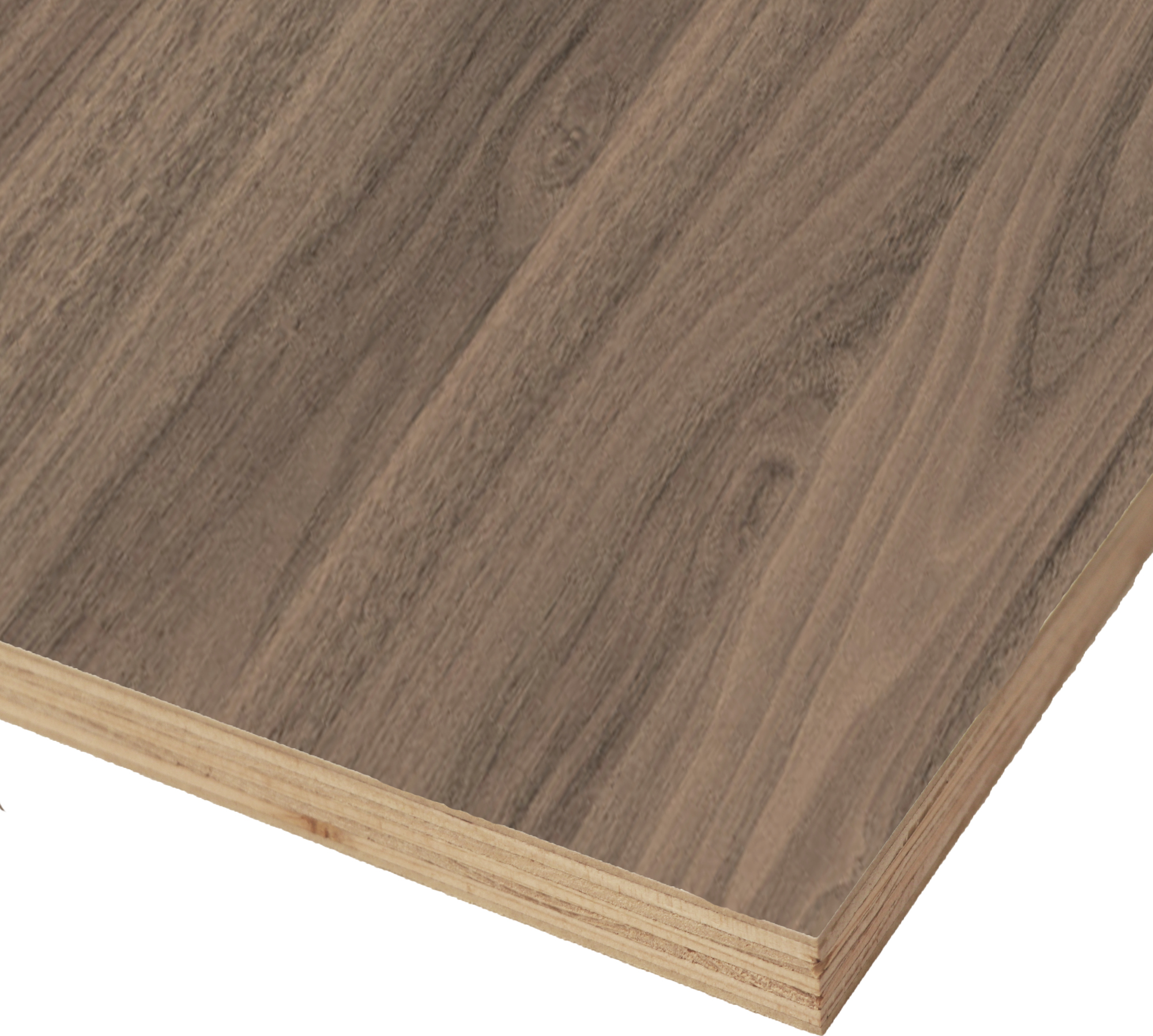
Walnut plywood is a hardwood-faced panel with a thin walnut veneer (0.5 to 0.7 mm typically) bonded over a softwood or MDF core. Black Walnut, Juglans nigra, drives most North American cabinet stock. European Walnut, Juglans regia, shows up on premium imports. Retail in the US runs $80 to $160 for a 4x8 of cabinet-grade material in 2026 — against $11 to $20 a board foot for solid walnut lumber. Cabinet shops we ship to in the US say walnut ply is what makes a dark contemporary kitchen pencil out instead of going over budget.
What is walnut plywood?
Composite panel. Walnut on the face, something cheaper underneath. The "something cheaper" varies by application:
Veneer-core. Built from rotary-peeled poplar or aspen veneers laid up cross-grain. Lightest. Best screw retention. Default for most cabinet construction. A 3/4 inch sheet weighs around 65 lbs.
MDF-core. A high-density fibreboard center, walnut veneer face. Smoothest face for finish. Heaviest by far — 95 lbs for the same 3/4 inch sheet. Screws barely hold. Use on door panels, never carcass.
Particleboard-core. Cheapest. Edges chip. Avoid for anything that wants a long service life.
The face wood is almost always plain-sliced (flat-cut along the log) for cabinet work. Rotary-cut shows a broader grain pattern that reads as cheap on a finished door. Quartersawn shows ray fleck and runs at premium pricing for craftsman-style work.
Why cabinet shops choose walnut over other hardwood ply
The face does it. Three things:
Color depth without stain. Walnut comes out of the kiln dark. Birch, maple, and ash all need stain to land on the same dark register, and stained pale woods always read slightly off — different grain pulling stain at different rates. Walnut just is that color.
Grain that takes finish without raising. Lacquer, oil, water-based polyurethane, shellac — all sit down on walnut without the grain popping back up the way oak and ash do. Less sanding between coats. Less time per panel.
Modest weight. The 65 lb veneer-core sheet handles fine on a one-man assembly. Compare a 95 lb MDF-core walnut sheet and you're either two-manning the cut or flipping it on a vacuum lift.
The trade is cost. Walnut runs 2x to 3x birch and maple. For a one-off furniture piece, fine. For a 30-sheet-a-month cabinet shop, the math has to work.
What walnut plywood gets used for
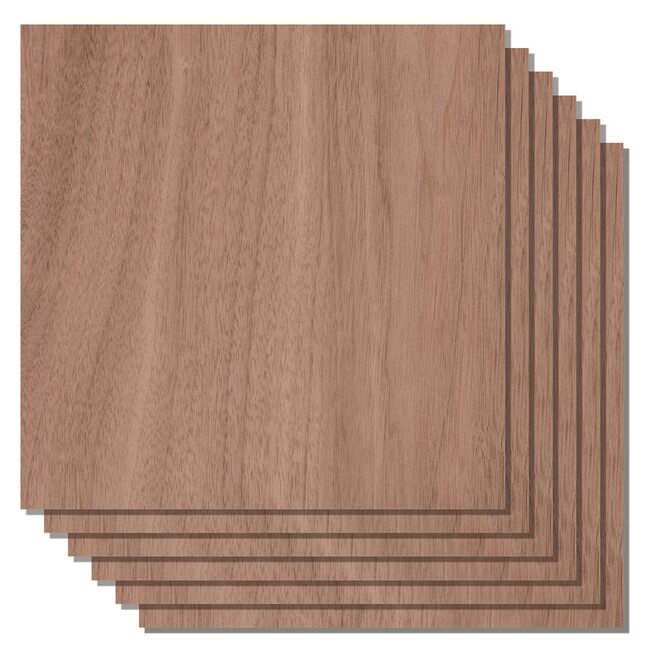
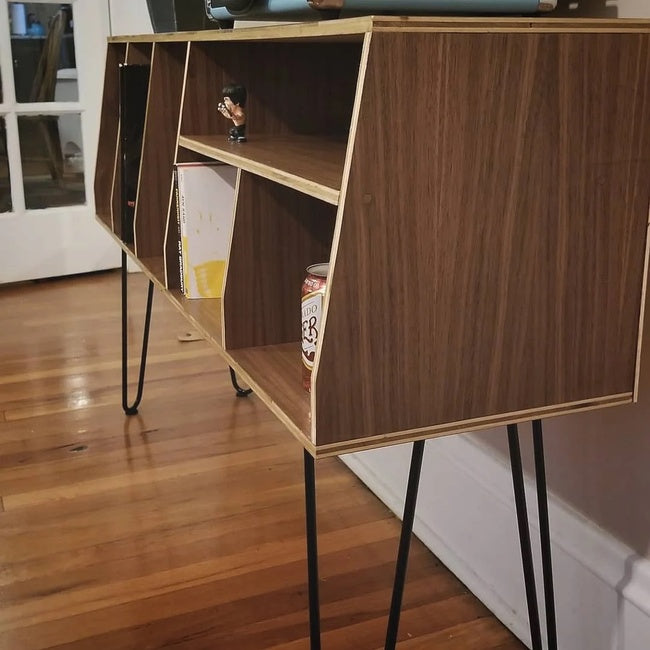
Inside-the-house, interior, dry. That's the envelope. Common applications:
- Upper cabinet boxes and door panels in dark-contemporary kitchens.
- Bookcase carcasses and library shelves where the face shows from across the room.
- Furniture tops, drawer fronts, and bed headboards.
- Speaker cabinets and audio equipment racks. Walnut has a small acoustic damping advantage over harder species.
- Interior flush doors with walnut veneer skin over a hollow or lumber-core.
- Architectural wall paneling, often book-matched or sequence-matched.
Where it does not work: outdoors (face checks fast under UV), wet areas (no waterproof glue line in cabinet-grade walnut), and high-wear horizontal surfaces like bar tops or kitchen islands. Walnut ply is veneered furniture wood. Treat it accordingly.
Veneer cuts that decide how the panel looks
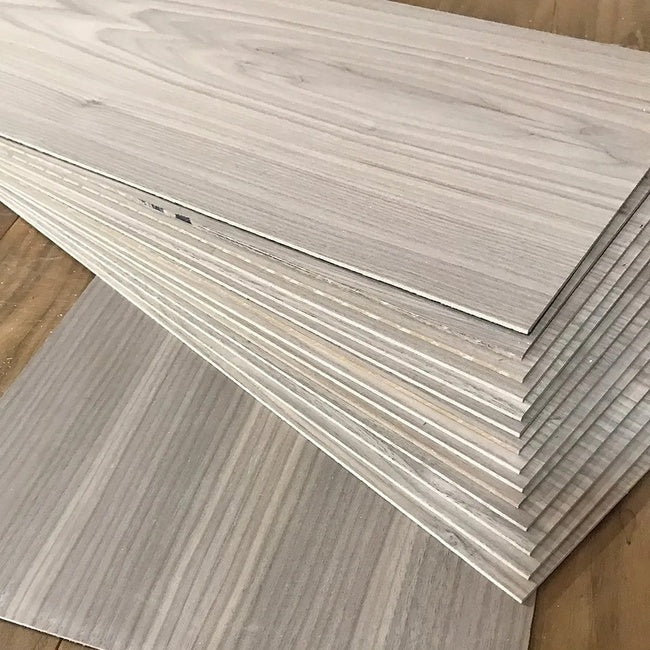
Same log can yield four different-looking faces depending on how the slicer is set:
Rotary-cut. The log spins, the knife peels a continuous sheet. Cheapest. Broadest grain pattern. Some occasional cathedral figure. Most stock from Asian and South American mills falls here.
Plain-sliced (also called flat-cut). The knife cuts along the length of the log. Tight grain with predictable cathedral figure. The North American cabinet default.
Quartersawn. Cut at 90 degrees to the growth rings. Straight grain. No cathedral. Occasional ray fleck on the face. Premium pricing for craftsman or shaker work.
Rift-cut. Cut at 45 degrees. Almost no grain figure at all. Used for modern flush-style cabinets where the door should read as one calm tone.
Pre-finished versus unfinished is the second decision. Pre-finished saves a finish step in-shop. Unfinished gives the finisher control over sheen and color. Most furniture and high-end millwork stays unfinished from the supplier.
Cost — what we see in early 2026
US retail across major distributors, January through April 2026:
- 1/4 inch (6 mm) rotary-cut, B/BB grade — $45 to $70 per 4x8
- 1/2 inch (12 mm) plain-sliced, A/B grade — $90 to $120 per 4x8
- 3/4 inch (18 mm) plain-sliced, A/A veneer-core — $110 to $160 per 4x8
- 3/4 inch quartersawn or rift-cut, A/A — $160 to $230 per 4x8
- 3/4 inch MDF-core, plain-sliced A/A — $130 to $170 per 4x8
Three drivers. Cut (rift > quartersawn > plain-sliced > rotary). Face grade (A/A > A/B > B/BB > C/D, with A/A meaning both faces are clear). Core (lumber-core > MDF > veneer-core > particleboard for price; lumber-core for stability and screw retention).
Lead time has stretched in 2026. Most distributors quoted 2 to 4 weeks for non-stock cuts in Q1, against the 1-week norm in 2024. Container costs and a thinner walnut log supply out of the Eastern US are the reasons distributors give us.
Walnut vs other hardwood ply
Walnut vs birch plywood
Birch is the workhorse. Pale, uniform, cheap, takes paint. If the cabinet's getting painted, use birch. Walnut for clear-coat where the face is the design.
Walnut vs maple plywood
Maple is harder, lighter, tighter-grained. Roughly 60% of walnut's price. Modern white kitchens — maple. Dark contemporary kitchens — walnut.
Walnut vs oak plywood
Oak is open-grained where walnut is medium. Oak is harder where walnut is medium. Oak runs around 70% of walnut. The visible difference is the grain showing through finish — oak's open grain stays open, walnut's closes up under lacquer.
Practical shop notes
What we hear from cabinet shops that run a lot of walnut:
- Score before the saw cut. Walnut face veneer chips on the upcut side. A scoring blade or a knife pass cleans it.
- Pre-drill. Walnut splits if a screw goes in cold. Even a 1.5 mm pilot fixes it.
- Edge-band before finish, not after. Walnut iron-on banding from the same veneer lot blends. PVC banding looks like plastic against the face.
- Store flat, off the floor, stickered. A warped sheet is a sheet that doesn't get used.
- Finish a sample piece first. Walnut takes finish so well that small grit or oil-amount differences turn into visible differences on the door.
Where to buy
Three supplier categories in the US:
Specialty hardwood dealers — Rockler, Woodcraft, Northland Forest Products, and regional hardwood yards. Best selection of cuts and grades. Highest prices.
Big-box — Home Depot and Lowe's stock 1/4 inch rotary-cut for hobby use. Cabinet-grade material isn't on their shelves.
Wholesale distributors — Columbia Forest Products, States Industries, Plum Creek. Best pricing on 10-sheet-plus orders. Most sell trade-only.
Vinawood does not manufacture walnut-faced plywood. Our face species are plantation Eucalyptus, Acacia, and Hevea, depending on the product range. Walnut ply is a North American category. Source it from a North American distributor with the species paperwork — Lacey Act and FSC chain-of-custody if it matters for the project. We get this question often enough that it's worth saying clearly: we do not have a walnut substitute, and we would rather not ship one than ship something that doesn't match the spec.
FAQ
What is walnut plywood made of?
A walnut veneer face over a softwood or MDF core. Most cabinet stock is veneer-core poplar or aspen. The face is what costs money; the core is what makes the panel work mechanically.
Is walnut plywood durable?
Janka hardness on Black Walnut is 1010 — harder than poplar (540), softer than red oak (1290). For interior cabinet and furniture use, fine. For high-wear horizontal surfaces (bar tops, kitchen counters), no. Veneer face wears like any veneered panel.
Is walnut plywood waterproof?
No. Cabinet-grade walnut uses interior glue (urea-formaldehyde, Type II / D2). Sustained wet exposure delaminates the face and swells the core. For wet locations use marine plywood with a phenolic glue line. Don't substitute.
Walnut plywood vs solid walnut?
Solid walnut costs more, weighs more, and moves with seasonal humidity (cup, twist, occasional check). Walnut plywood holds its shape across humidity swings and runs roughly half the cost per square foot of finished surface. Most modern shops use plywood for boxes and solid for face frames or any rail that has to take a profile.