Film Faced Plywood for Concrete Formwork: The Complete Guide
Film-faced plywood for concrete formwork is two specs: a phenolic face film and an MUF or PF core glue. Uses and sizes by grade, with reuse up to 8 to 20 pours. Vinawood, est. 1992, ships factory-direct to 55+ countries.
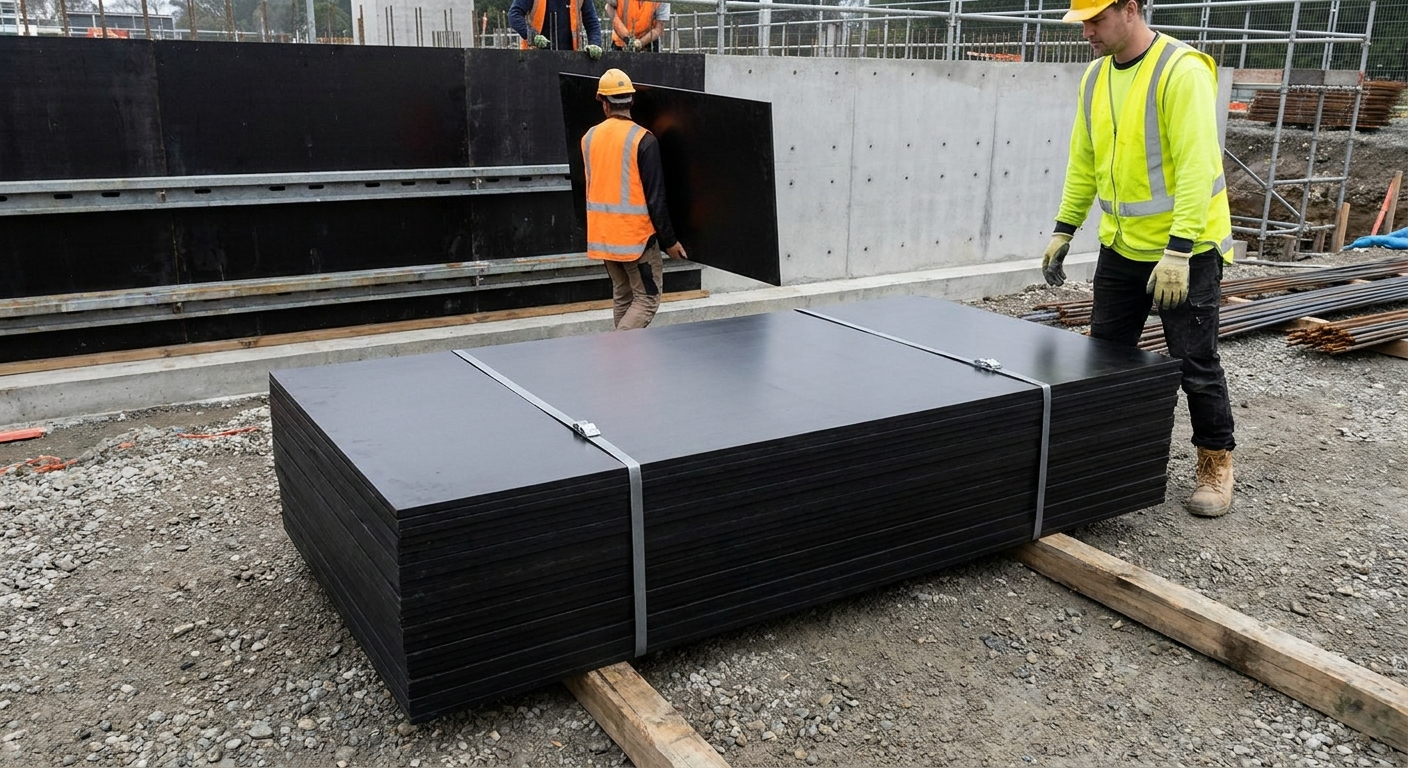
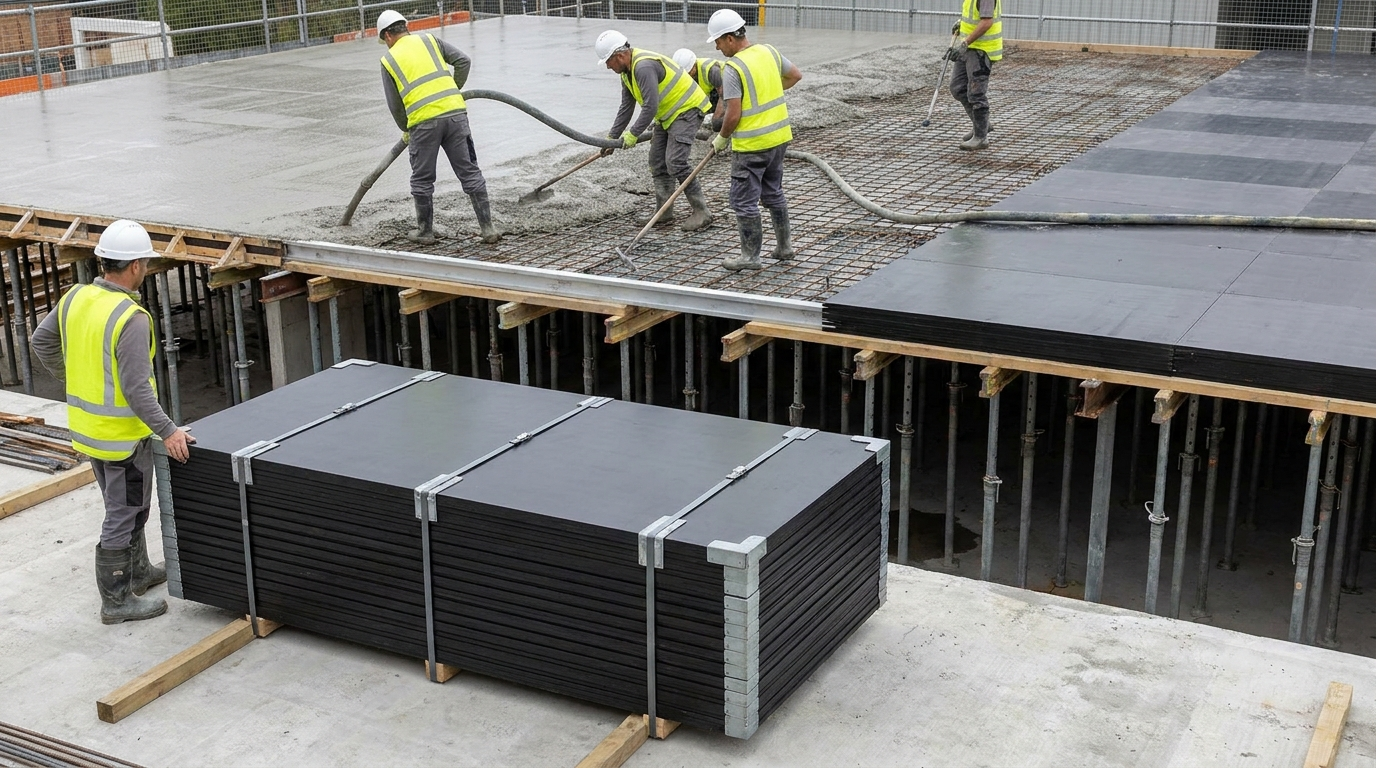
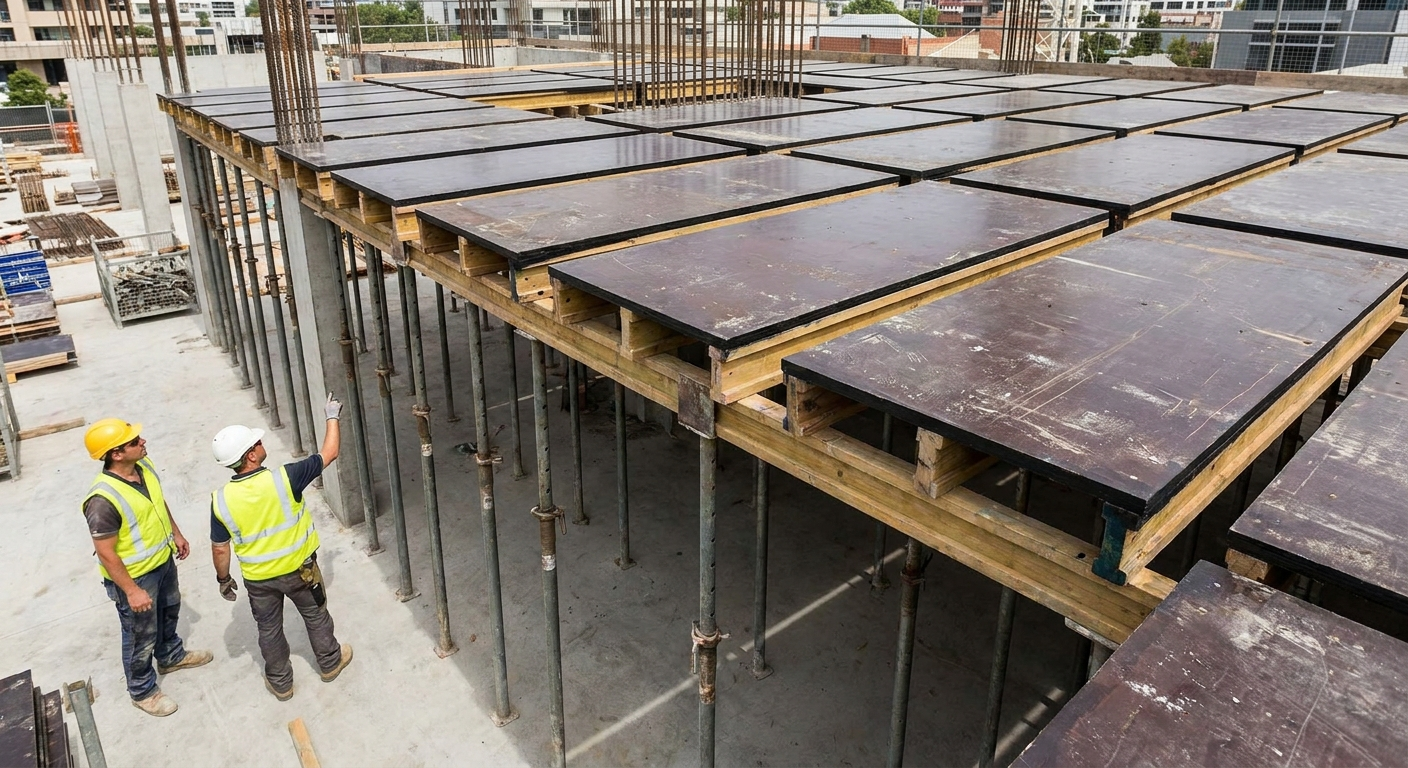
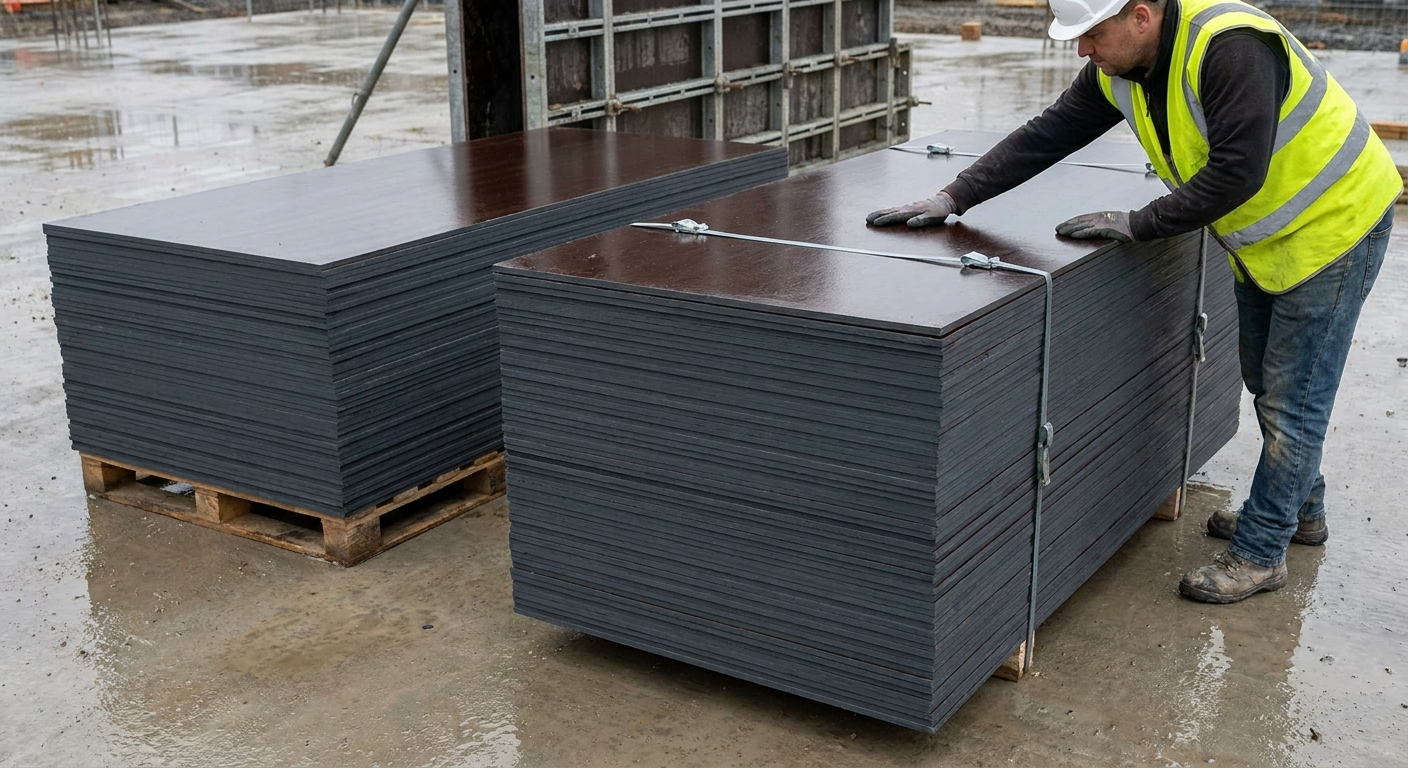
Film faced plywood is a hardwood plywood panel with a phenolic resin-impregnated film pressed onto both faces, built to be poured against, stripped and set again as concrete formwork. Contractors and importers reach it through a handful of names: shuttering plywood in the UK and the Gulf, formply in Australia, concrete form plywood in North America, and phenolic board or brown film plywood on many trading lists. Formply is the Australian name for the same family of overlaid formwork panels, graded there against a local stress-grade standard, and the film-faced plywood vs formply comparison walks through where the two specs differ. Formwork plywood is the generic name for any plywood built to be poured against and reused, and film-faced plywood is the most common form of it on construction sites today. Whatever the search term, the sheet on the quote is the same family, and the grade is decided by the glue class underneath the film.
Taken straight from our product data, the ladder reads like this. Form Basic has a plantation-grown acacia core, a 165 g/m² dark-brown phenolic film on both faces and a water-resistant MUF (melamine-urea-formaldehyde) glue line rated EN 636-2, Class 2. Pro Form keeps an acacia core under a 125 g/m² phenolic film and switches to WBP phenolic glue, which lifts it to Class 3. In the North American overlay family, HDO Basic is listed at Class 2, so a buyer who needs Class 3 there should name HDO Standard or HDO Premium, or one of the MatteFace Class 3 grades covered further down. Film-faced sheets come in 2440×1220 mm and 2500×1250 mm, in thicknesses from 11.5 to 21 mm. Vinawood has pressed film faced and phenolic formwork plywood in Vietnam since 1992 and ships about 5,000 containers a year to 55+ countries, so the quickest route to a grade match is to send the pour programme through the RFQ form.
Because wet concrete hits the film rather than bare wood, the strip comes cleaner and grain print drops. Reuse is published as a maximum on the product data sheet when edges stay sealed and the crew strips on schedule.
Two lines decide the RFQ before price ever should. Core glue is either MUF (melamine-urea-formaldehyde, EN 636-2) or PF (phenol-formaldehyde, EN 636-3 / Class 3). Face film is the phenolic overlay that touches the pour. Confuse them and you write "phenolic" on an MUF panel because the face is brown.
This guide stays on the film-faced sheet itself: glue, film, grade and the RFQ. If you are comparing overlay families such as HDO, MatteFace and film-faced side by side, the concrete forming plywood guide covers that ground. Soffit layout and joist spacing are on plywood for slab formwork, and the broader case for timber formwork, with regional standards, is in formwork plywood advantages and types.
Core glue and face film are separate specs
Stop treating "film faced plywood for concrete formwork" as one SKU. On every TDS you should read two independent lines, because each one fails in a different way on site. Core glue is the adhesive between veneers - the chemistry that survives when water reaches a screw hole or a site cut. On the Vinawood film-faced line that means MUF (water-resistant WBP, EN 314 Class 2 / EN 636-2) or PF (water-resistant WBP, EN 314 Class 3 / EN 636-3). Face film is the phenolic-impregnated paper that touches concrete, pressed on at 125 g/m² on Pro Form and 165 g/m² on the other film-faced grades, so it is paper-thin rather than a visible extra ply. On this range the film is phenolic on every grade, which is why "phenolic plywood" on a quote should also mean a PF glue line; ask the seller to state the EN 636 class so the word cannot hide an MUF core.
A panel with MUF glue and a phenolic face is a real EN 636-2 formwork sheet. A panel with PF glue and the same face moves into EN 636-3 and a higher reuse card. The brown face does not name the glue. Glue-versus-film detail sits on melamine vs phenolic film-faced plywood and on phenolic plywood.
What "melamine" actually means on an RFQ
On a formwork RFQ the word "melamine" can point to three different things, and an order goes wrong when buyer and seller mean different ones. The first is the core glue: melamine-urea-formaldehyde (MUF) resin bonds the veneers on Eco Form Plus and Form Basic, listed on the data sheet as WBP Melamine Standard, and on Form Extra, listed as WBP Melamine Top, and all three sit in EN 636-2, Class 2, with reuse ratings of up to 8, up to 10 and up to 15 respectively. The second is a melamine face film, a surface overlay made from melamine-saturated paper, which the Vinawood formwork range does not use because every film-faced grade carries a phenolic face. The third is decorative melamine laminate for cabinetry, which has nothing to do with formwork, so the "interior only" reputation of that board should never be carried over to an MUF formwork panel that is rated for humid conditions.
The simplest fix is on the purchase order. Ask the mill to write MUF and the EN 636 class against every line, and the word melamine stops causing arguments when the container is opened.
Why crews specify film-faced for formwork
People search "why film faced plywood is used in formwork" for a practical reason. The overlay releases cleanly, the sheet cuts on site, and reuse is a published up-to figure on the data sheet rather than a rumour. Steel and aluminium systems win on identical high-rise bays with crane time. Most walls, columns, and cut-up slabs still want a sheet you can saw without waiting on a fabricated table for every opening.
Formwork is a large slice of a concrete package. Wrong panel shows up twice: once in the pack, again in grind and patch. Film-faced earns the spec when you need a fair-face or a predictable strip. Shuttering language is the same product family; see the shuttering plywood guide.
Release agent, prompt scrape, and flat stacking are how you actually reach the spec-sheet figure. Skip those and a Pro Form sheet behaves like a lower grade by pour six. An 18 mm sheet still fits a circular saw and a two-person carry. The overlay forgives a wet weekend if the edges were sealed.
Cost follows reuse class more than sheet price, and a quote through the RFQ form is the place to compare the two. A higher reuse rating on the spec sheet is cheaper per pour only if you actually run those cycles and you clean the sheets. An economy panel that delaminates on pour four is not a bargain.
Grade and reuse ladder
Which film-faced plywood is best for concrete formwork? The best sheet is the least expensive grade whose glue class and reuse rating match the pour programme you actually have. Covered work and short programmes sit comfortably on Form Basic or Form Extra, both EN 636-2. Rain between pours, an engineer who has written EN 636-3, or a long run of reuses points to Pro Form Lite or Pro Form. Fair-face work adds two conditions on top of the grade: a clean phenolic face and edges that are sealed after every cut.
The ladder below sets out how the grades step up. Reuse figures are maximums from the product data sheet, reached when edges stay sealed and crews strip and clean on schedule, and floor count on a building is not the same thing as a cycle count. Commercial Bintangor plywood does not appear here because it is not a film-faced product.
Eco Form Plus (MUF, Class 2, up to 8 reuses). This is the entry rung, built for short programmes and light commercial jobs where the pours are covered and the sheets will not sit out in the weather for weeks. It keeps the phenolic face, so release and strip quality are still good. Where the programme is likely to grow, it pays to price the next rung at the same time.
Form Basic (EN 636-2, MUF, up to 10 reuses). Form Basic is the standard sheet for commercial walls and slabs that stay inside the Class 2 envelope. Most mid-rise residential and light commercial work fits here when the engineer has not called for Class 3. It is the grade many importers stock as their everyday line.
Form Extra (Superior Glue MUF, listed as WBP Melamine Top, EN 636-2, up to 15 reuses). Form Extra stays in Class 2 alongside Form Basic and wears the same phenolic face, so the extra cycles come from the glue chemistry rather than a heavier film. It is not Class 3 and it does not use phenolic glue. I still see packs labelled "Class 3 Form Extra" on distributor spreadsheets, while the mill data sheet says EN 636-2, and the time to correct that is before the pour.
Pro Form Lite (SKU FFP0510, WBP phenolic, 165 g/m², EN 636-3 / Class 3, up to 15 reuses). Pro Form Lite is the first PF glue, Class 3 rung, sitting between Form Extra and Pro Form. It suits a job where the engineer has named Class 3 but the programme does not need the top reuse rating.
Pro Form (WBP phenolic, EN 636-3 / Class 3, up to 20 reuses). Pro Form is the long-cycle sheet for infrastructure, exposed weather and fair-face work. Its PF glue line holds up when water reaches screw holes and site cuts, which is where lower grades usually start to fail. It carries the highest reuse rating on the film-faced ladder.
Across the whole range, the Class 3 grades are Pro Form, Pro Form Lite, HDO Standard, HDO Premium and MatteFace Panel 1S, Panel 2S, 1SF and HD 1SF. HDO Basic, Form Basic, Form Extra, Eco Form Plus and MatteFace Eco 1SF are Class 2. P-Form is a polypropylene-faced product rather than a film-faced plywood, so it should never be ordered as Pro Form.
Film weight, size, and layout
Standard formwork plywood sizes on the Vinawood film-faced grades are 2440×1220 mm and 2500×1250 mm, with thicknesses from 11.5 mm up to 21 mm and 12, 15, 18 and 21 mm offered across Eco Form Plus, Form Basic and Form Extra in both sizes. Size follows the formwork system, thickness follows pour pressure. Film weight controls surface life. It does not upgrade the glue class. If the job is EN 636-3, a heavier film on an MUF core still fails the spec.
On the Vinawood film-faced range the product data lists two film weights. Pro Form carries 125 g/m², while Form Basic, Form Extra, Pro Form Lite and Eco Form Plus carry 165 g/m². That means Form Basic and Form Extra share the same face, and Form Extra's longer reuse comes from its higher-grade MUF glue rather than a thicker overlay. Writing both the film weight and the EN 636 class on the RFQ stops anyone from "upgrading" the film and assuming they have bought Class 3.
European formwork systems are built around 2500×1250, while North America and many Asian yards run 2440×1220, and both sizes sit in the mill catalogue. Larger modular sizes can be made as a special order, so raise them early in the RFQ rather than after the price is agreed. Whatever the size, every site cut needs edge sealer straight away, because unsealed edges are the usual reason a sheet dies early. Edge paint is a water-resistant sealer, not a marine coating.
Thickness is a span and pour-pressure question: 18 mm is the workhorse for walls and columns, 12 mm suits edges and low pressure, and 21 mm takes heavy walls and deep pours. Millimetre-by-pour tables live on the formwork plywood thickness guide.
Core on the Vinawood film-faced range is plantation-grown hardwood, acacia on the grades in the ladder above. Poplar cores save weight but cut reuse. Match the core to the card you actually bought.
Always name the EN 314 class on the purchase order rather than just "WBP", because trade slang applies WBP to both Class 2 and Class 3 glue lines. Interior UF glue is not formwork, and a sheet with no class on the certificate is one to walk away from.
Distributor logo film is a separate mill job. Artwork, plates, and pack marks sit on the OEM logo film-faced plywood guide.
Film-faced vs HDO vs MatteFace
US and Canadian buyers often ask for HDO or MDO instead. They are overlay equivalents for formwork, not a country-supplier tour.
In the HDO plywood range, HDO Basic is Class 2 with reuse up to 10, while HDO Standard and HDO Premium carry Class 3 and run up to 20. MatteFace Plywood (MTF) is a matte-faced formwork panel rated up to 15 reuses on Panel 1S and 1SF, up to 17 on HD 1SF and up to 25 on Panel 2S. MatteFace Panel 1S, Panel 2S, 1SF and HD 1SF are WBP phenolic, EN 636-3, Class 3, while MatteFace Eco 1SF, bonded with M-Bond glue, is the Class 2 option in that family. North American crews who ask for MDO-style forming ply are usually describing MatteFace. Side-by-side overlay language is on film faced vs MDO vs HDO.
Pick film-faced when the spec is EN film overlay and 1250×2500. Pick HDO when the US yard wants a high-density overlay. Pick MatteFace when the soffit or wall wants a matte face rather than gloss film.
What is film faced plywood used for?
Film faced plywood is used for concrete formwork on slab decks, walls, columns, foundations and beams, and for exposed or fair-faced concrete where the finished face will be seen. Outside the pour itself it also turns up in temporary works such as site hoarding, where a smooth, water-resistant face is needed for a limited period. Each of those uses points to a grade. Covered work and short programmes sit well on a Class 2 grade such as Form Basic, while long reuse runs, wet weather between pours and fair-face finishes call for a Class 3 grade such as Pro Form Lite or Pro Form.
Walls are the volume job, usually in 18 mm with the bond class set by the engineer. Slab formwork is mainly a question of deflection under wet load, so joist spacing matters as much as the sheet. Column and beam boxing involves a lot of cutting, which means every saw cut needs sealing before the sheet goes back into the cycle. Bridges and deep foundations usually call for Pro Form or HDO Premium at 21 mm in Class 3, and fair-face architectural work wants the heavier phenolic film with a clean release agent rather than a low-grade sheet that will need grinding later.
Covered indoor pours can live on Form Basic or Form Extra if the engineer stayed on EN 636-2. Rain between pours, or a spec that names Class 3, is Pro Form Lite or Pro Form. Do not "make it phenolic" by ordering a heavier film on Form Extra. The glue class does not move.
The film-faced plywood collection is the Europe parent. Vinawood supplies factory-direct from its mill in Vietnam rather than through a retail store, and ready stock for local distributors also ships from Vinawood warehouses in Toronto, Vancouver, Calgary, Montreal, Miami, Houston, and Baltimore when the programme needs a fast fill.
Mistakes that kill a film-faced pack
The most expensive mistake is buying on sheet price alone. Reuse class and site care set the real bill, so a cheaper panel that delaminates on pour four costs more per pour than a better grade that runs its full cycle count. The second is skipping the core: ask for a cross-section photo before the order is confirmed, because an unknown mix of species is an early warning sign.
On site, the usual failure is cut edges left open. Every saw cut needs edge sealer straight away, otherwise water gets into the veneers and the sheet swells long before the film wears out. Thickness causes a quieter loss when a single size is ordered for the whole job; mixing 12, 18 and 21 mm to the pressure and span saves material and keeps deflection where the engineer wants it.
Glue class mistakes run both ways. If the engineer has named EN 636-3, Form Extra will not pass however good its face looks, and reading the brown film as proof of a phenolic panel is exactly how that happens. The opposite waste is putting Pro Form on a six-pour covered house slab that Form Basic would have handled.
ISO 9001, FSC-COC, CE marking to EN 13986 and EPA TSCA Title VI are the papers to request, with certificate numbers. A mill that cannot produce a TDS with glue class and film weight is not ready for a container.
What to put on a film-faced RFQ
Send overlay (film-faced vs HDO vs MatteFace), bond class (EN 636-2 or EN 636-3), film weight where the catalogue supports it, size (2440×1220 or 1250×2500), and reuse class. Emission class if the destination asks. That list gets a far more useful answer than a request that just says "film faced plywood" with no product data sheet behind it.
Vinawood has made formwork plywood since 1992, ships about 5,000 containers a year to 55+ countries, and runs a 12-step process with 100% sheet inspection. Cores are plantation-grown and every container ships factory-direct from Vietnam. Request mill specs or start an RFQ and we will map Eco Form Plus through Pro Form, or HDO and MatteFace for a North American overlay, against your pour programme.
Category
how-to
Related Markets
Related Countries
▶Sources & References (3)
- APA Plywood Design Specification - PS 1-19 — APA - The Engineered Wood Association (2019-01-01)
- EN 13986 - Wood-based panels for use in construction — CEN (European Committee for Standardization) (2015-06-01)
- EN 314-2 - Plywood bonding quality — CEN (European Committee for Standardization) (2001-12-01)