Film Faced Plywood vs Marine Plywood: Which Do You Need?
Film-faced vs marine plywood: phenolic film for concrete formwork reuse vs a void-free marine core for permanent wet duty, what WBP means on a quote from Vietnam, and bond class by grade.
The short answer comes first. If the sheet is going to be poured against, you want film-faced plywood; if it is going to live in water for years, as a hull, a jetty deck or a wet-room substrate, you want marine plywood. Both carry a water-resistant WBP glue line, which is why buyers often group them together, but the resemblance ends at the glue. Film-faced plywood has a phenolic resin film pressed onto the face so that cured concrete releases cleanly and the panel can go back up for the next pour. Marine plywood has no film at all, and its value sits in a carefully graded core that gives water nowhere to collect during a long service life.
For buyers sourcing WBP film-faced plywood from Vietnam, the letters WBP on a quote describe a water-resistant, boil-resistant glue line rather than one specific glue. On Vinawood grades that line is either a melamine-based MUF core glue on the Class 2 grades, listed as WBP Melamine Standard or WBP Melamine Top on the data sheet, or phenol-formaldehyde (PF) glue, listed as WBP Phenolic, on the Class 3 grades. A usable quote therefore states the glue label next to its EN 636 class, the face film weight in g/m², the plantation-grown core species, the thickness and sheet size, the reuse ceiling written as "up to" a number, and the packing. It should also name the loading port, usually FOB Hai Phong, so every supplier you compare prices freight on the same basis.
Mixing the two products up costs money in both directions. Order marine for a forming job and you pay for selected veneers, then watch a bare face grab the concrete and lose its finish after a few strips. Put film-faced sheets into a permanent marine structure and you ask a pour panel to do work its core was never graded for. Vinawood has made plywood in Vietnam since 1992 and ships about 5,000 containers a year to 55+ countries, and a large share of the mismatched RFQs we receive trace back to this one decision.
Film-faced plywood in one screen
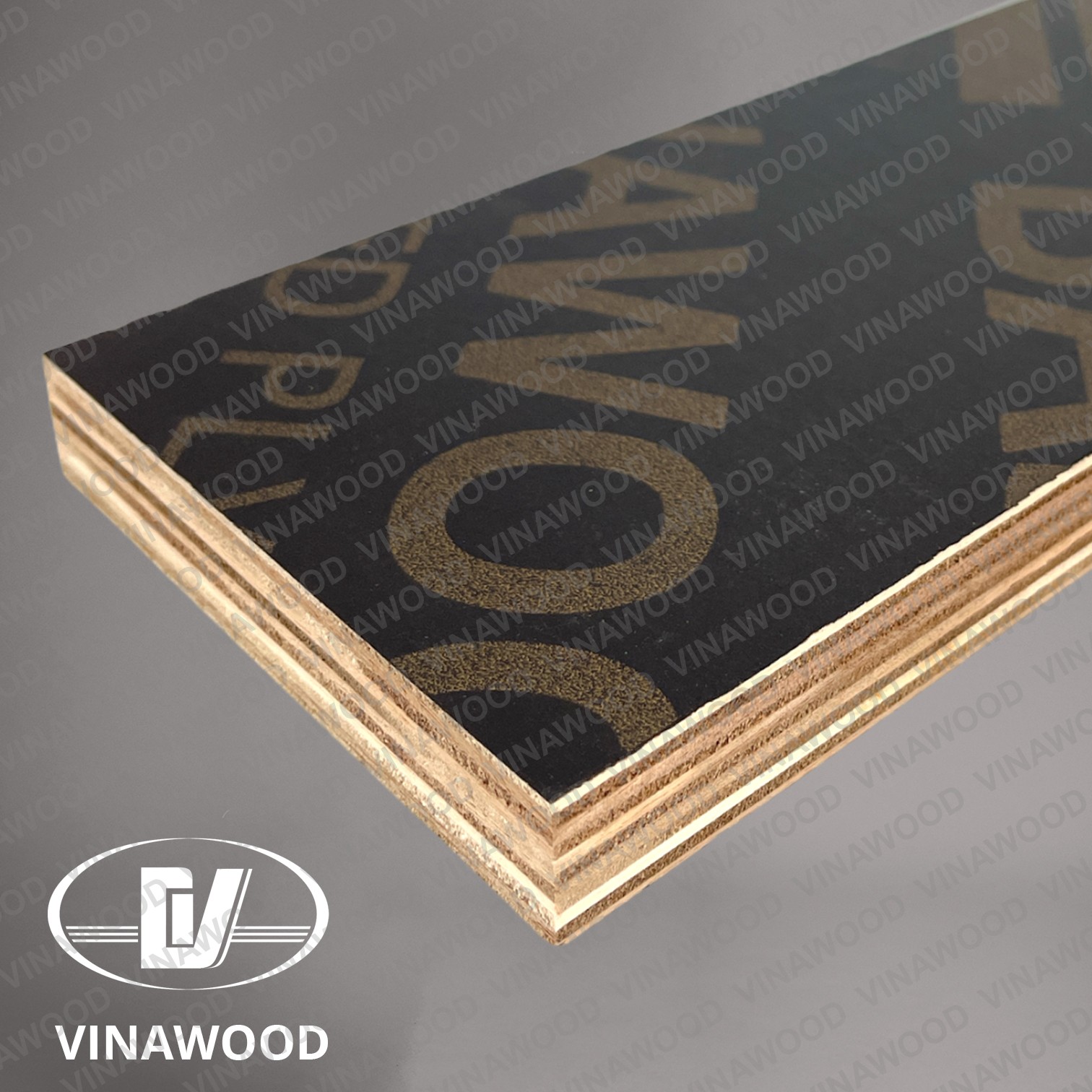
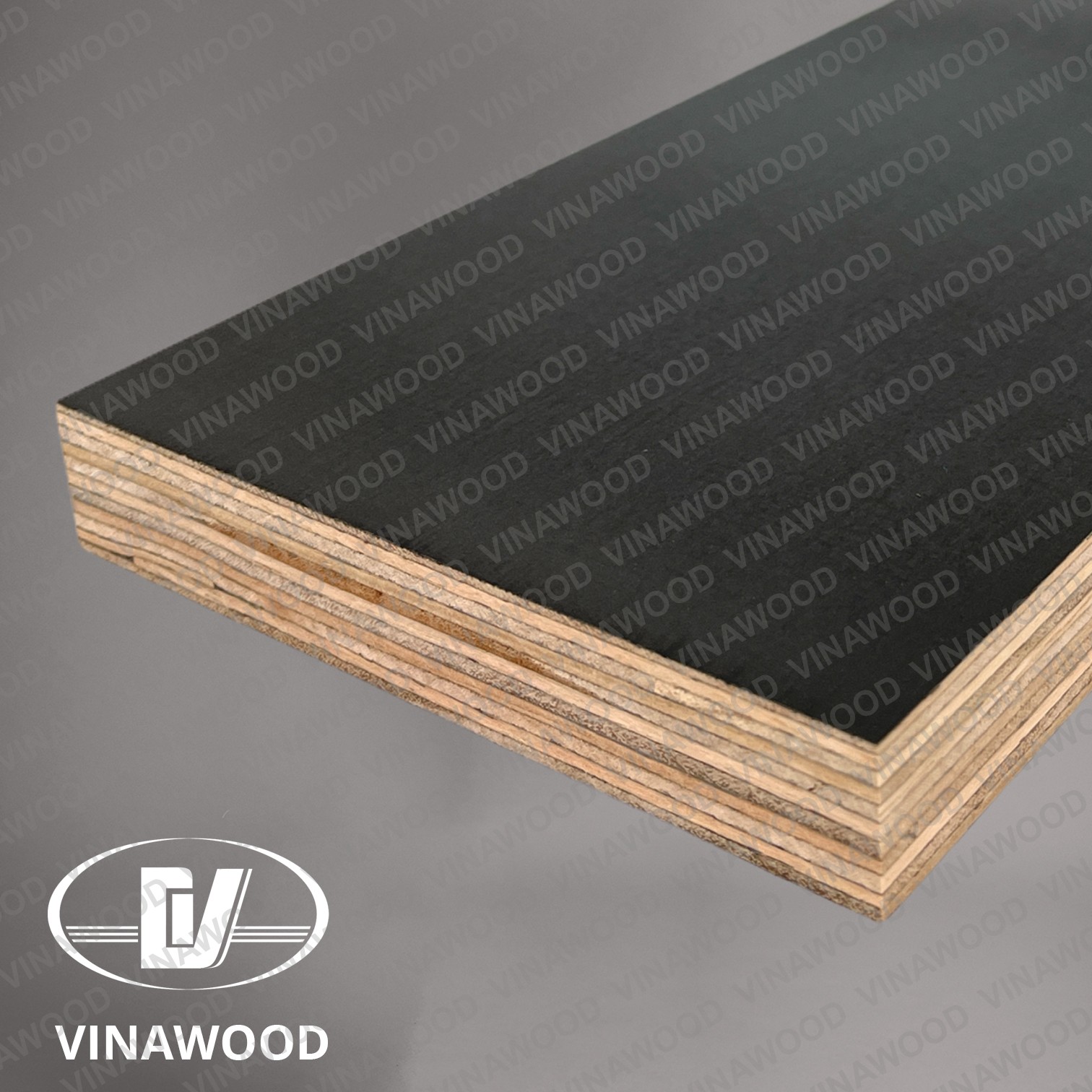
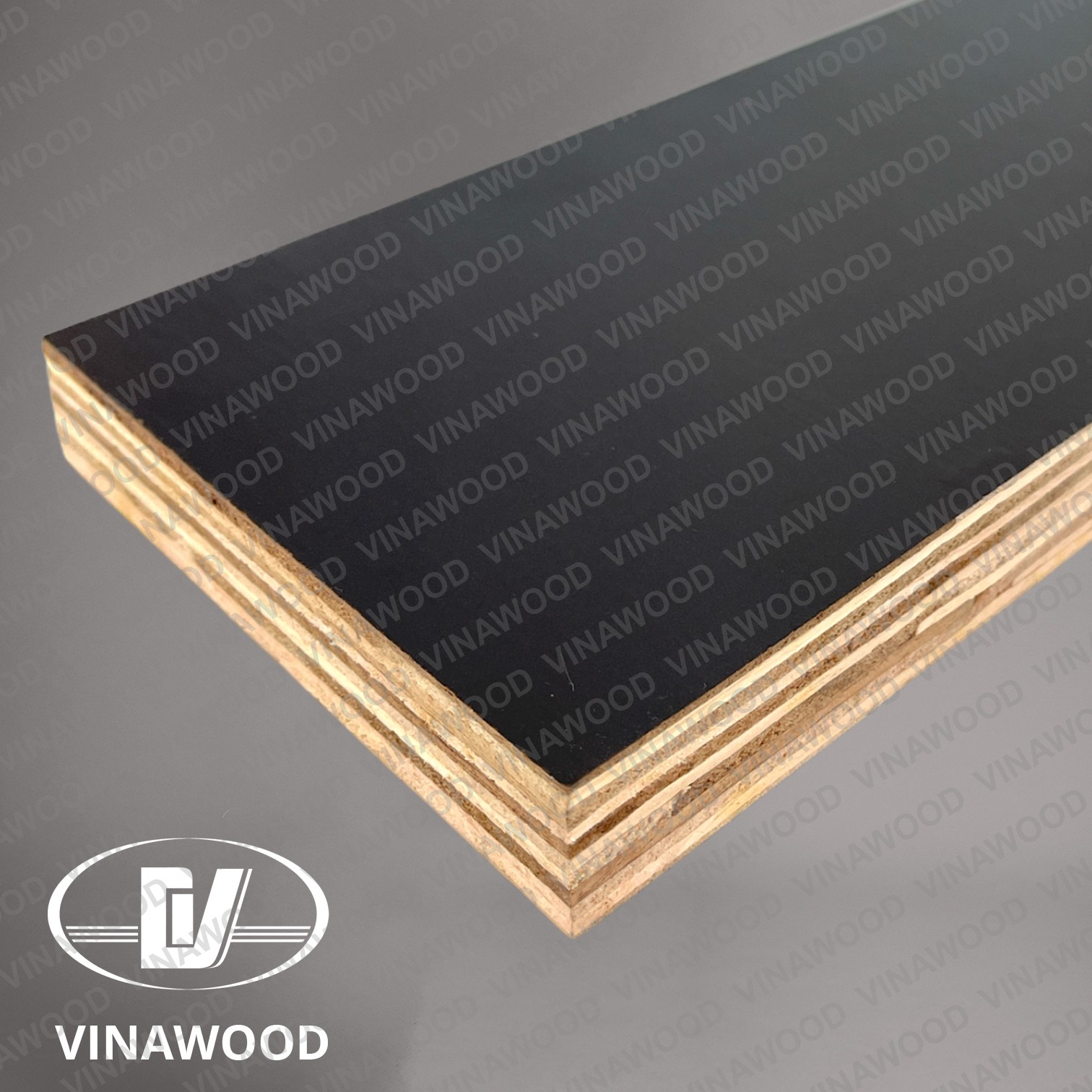
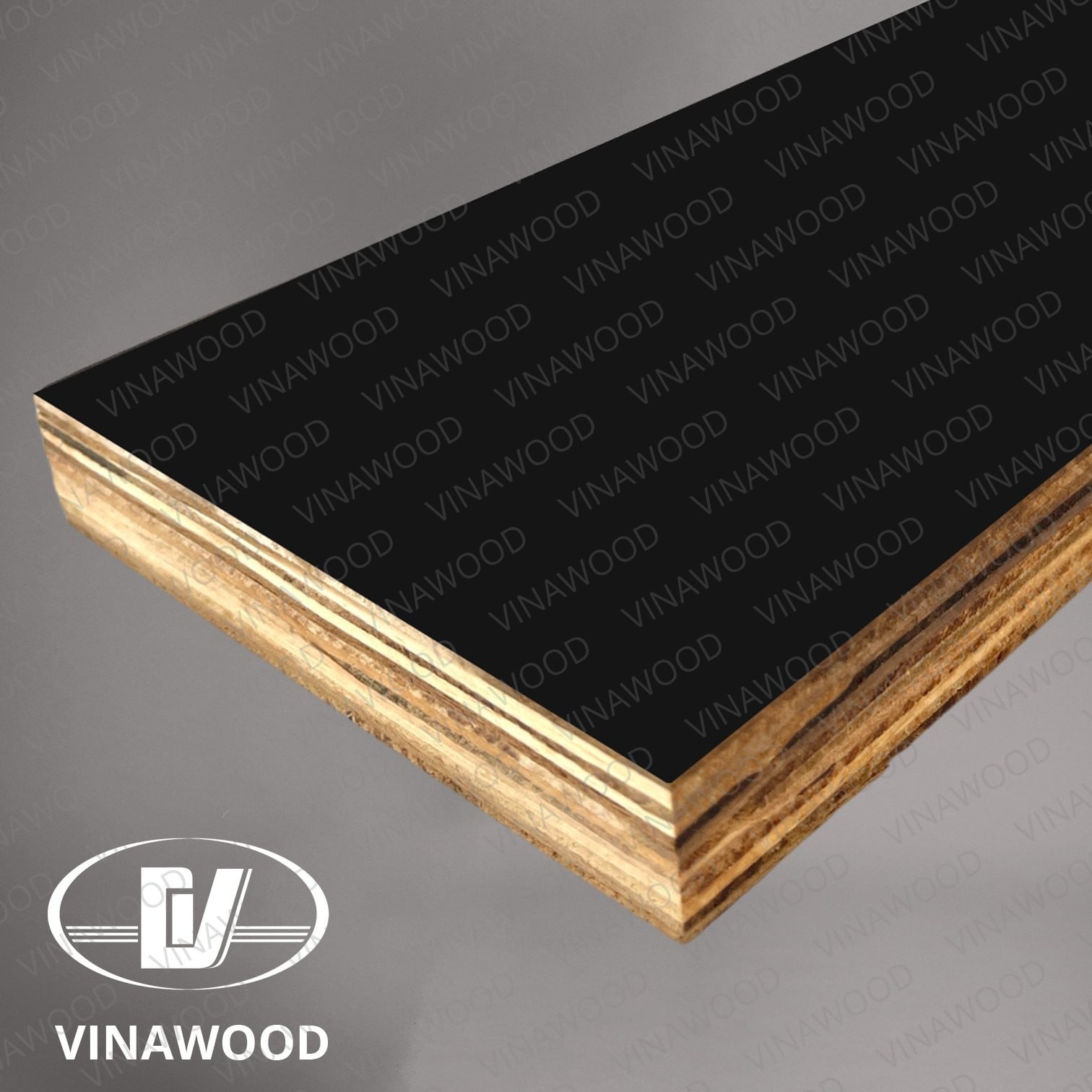
Film-faced plywood starts as ordinary cross-laminated hardwood plywood and then receives a hard, plastic-like skin. That skin is phenolic resin film, hot-pressed onto one face or both, and it is what allows the sheet to shed wet concrete and leave a smooth wall behind. Underneath sit plantation-grown hardwood veneers, acacia on most of our film-faced grades, bonded with a WBP glue line whose chemistry depends on the grade. Some grades use MUF (melamine-urea-formaldehyde) core glue and others use PF, a difference that matters once an engineer names a bond class.
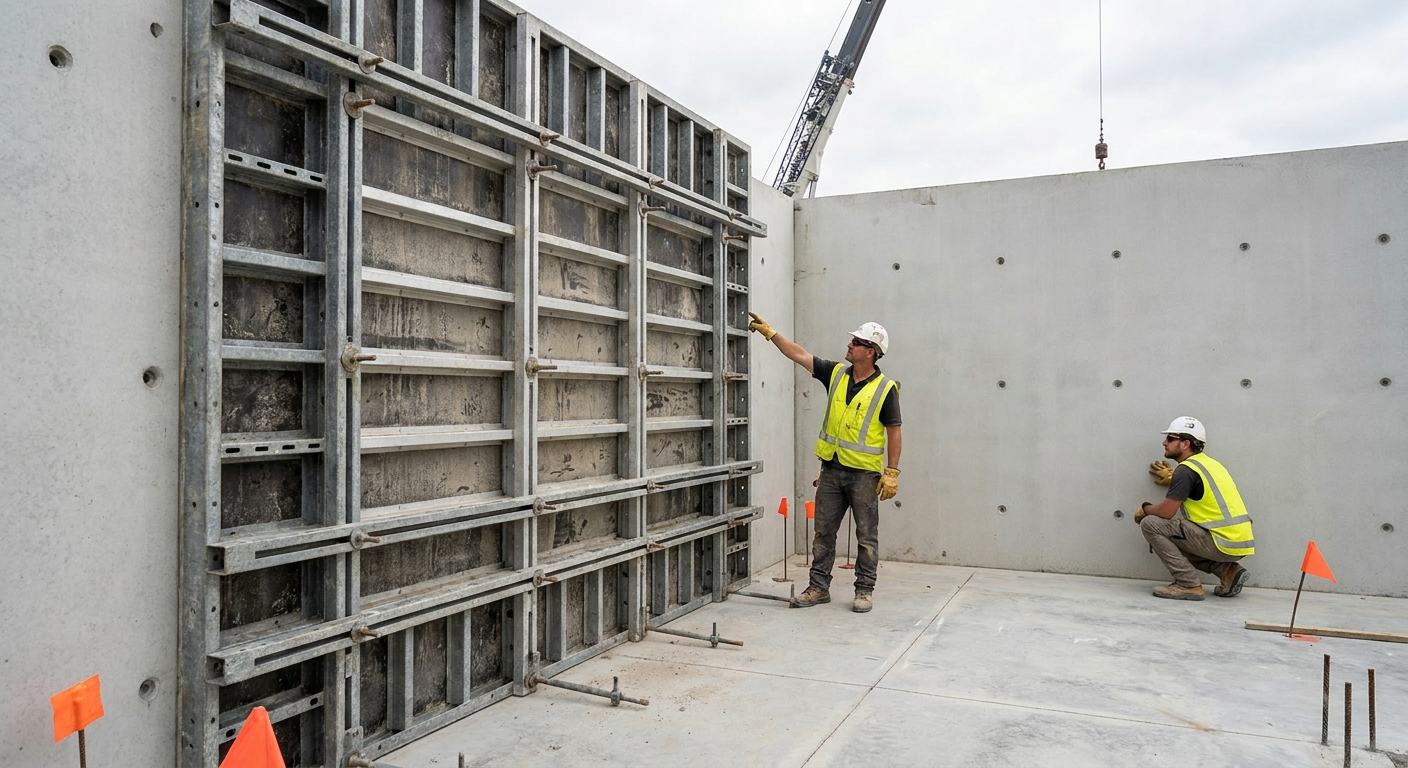
Concrete formwork is the main job, and reuse is what buyers are really paying for. Our top phenolic grades are rated for up to 20 reuses when crews strip on time, seal cut edges and store the sheets flat. That figure is a ceiling, and whether a site reaches it depends far more on handling than on the panel itself.
In Europe the data sheet will state EN 636-2 for humid conditions or EN 636-3 for exterior conditions, with a CE mark when the panel goes into construction. Depending on the market, the same sheet may be called phenolic plywood, shuttering ply or simply formwork ply. One trap catches new buyers regularly: the film on the face and the glue in the core are separate specifications, and a dark brown face says nothing about the glue behind it. Our guide to MUF core glue vs phenolic film-faced plywood walks through that split, and the phenolic plywood guide covers the PF grades in more depth.
Marine plywood in one screen
Marine plywood is selective plywood. The face, the back and the inner plies are chosen veneers, and the standard most buyers quote, BS 1088, does not allow gaps or knot holes to pass into the core. A void inside a wet panel becomes a pocket where water sits and decay begins, and in a boat transom that pocket ends the panel's life. Australian buyers usually specify AS/NZS 2272 instead, which looks at the same things: core quality and the durability of the glue bond.
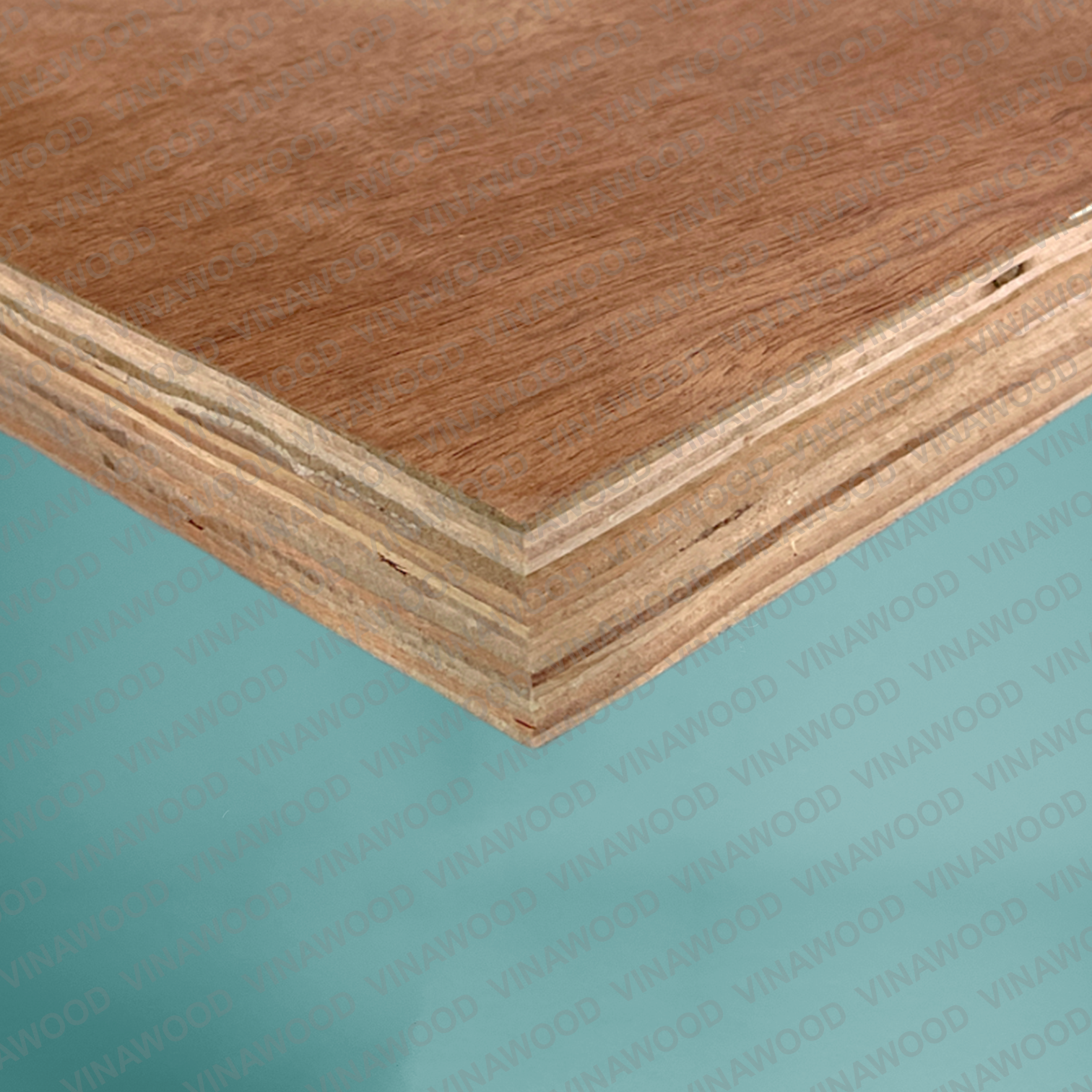
The word "marine" describes core quality and bond, not a surface. A marine sheet arrives with a bare sanded face, usually B grade or better, which suits paint, varnish or laminating. That same bare face is a poor match for formwork, where crews need a sealed surface that concrete cannot key into. You can browse Marine Standard and Marine Extra in the marine plywood collection.
Key differences at a glance
| Feature | Film-faced plywood | Marine plywood |
|---|---|---|
| Surface | Phenolic resin film (smooth, sealed) | Bare sanded veneer (no film) |
| Core quality | Construction-grade plantation-grown veneers for formwork | Selected veneers, graded to keep voids out of the core |
| Adhesive | WBP (MUF or PF, by grade) | WBP (check the glue label and EN 636 class) |
| Primary use | Concrete formwork | Boats, docks, permanent wet structures |
| Reusability | Up to 8 to up to 20 reuses by grade | Not designed as a pour-cycle panel |
| Concrete finish | Smooth, sealed film face | Wood grain transfers to the concrete |
| Moisture behavior | Water-resistant face; cut edges need sealing | Durability depends on core grade and glue bond |
| Typical thickness | 12 to 21 mm | 6 to 25 mm |
| Relative cost | Lower at equal thickness for formwork duty | Higher, because every ply is selected |
Is film-faced plywood waterproof?
No, film-faced plywood is water-resistant rather than waterproof. The phenolic film keeps water and cement paste off the face, and the WBP glue line holds the plies together through repeated pours and wet weather on site, which is exactly the duty the panel is built for. The weak points are the cut edges and any drilled holes, where bare veneer is exposed, so those need sealing before the first pour or the core will take on water between cycles. The same answer applies to any film face panel sold for formwork: it tolerates rain and wet concrete, while permanent immersion is a different job.
Marine plywood is not waterproof either, despite the name. What keeps a marine panel in service when it stays wet is the graded core and the glue rating, and an untreated marine sheet left in standing water will still swell at the edges over time. Boatbuilders coat and seal marine ply for that reason.
Formply vs marine ply
Australian buyers ask this one often. Formply is the Australian name for film-faced formwork plywood, and over there it is stress-graded under AS 6669, with F17 the grade most people mention. Marine ply in Australia answers to a separate standard, AS/NZS 2272, which is concerned with the core and the glue bond rather than with pour cycles. "Film-faced plywood vs formply" is therefore not really a contest, since it is one product under two names, and the useful comparison is between F-grade, bond class and film. Australian buyers will find stress grades and off-form surface classes explained in our film-faced plywood vs formply guide.
When to choose film-faced plywood
If concrete is involved, the answer is film-faced. On walls, slab decks, columns, footings and precast beds, the value lies in how many pours a sheet survives and how cleanly it strips each time. Contractors also use it for trailer flooring and site hoarding.
Our film-faced range steps up by core glue and reuse rating:
- Eco Form Plus: WBP MUF core (WBP Melamine Standard), EN 636-2, up to 8 reuses.
- Form Basic: WBP MUF core (WBP Melamine Standard), EN 636-2, up to 10 reuses.
- Form Extra: higher-grade MUF core (WBP Melamine Top), EN 636-2 (not Class 3), up to 15 reuses, with the same phenolic face film as Form Basic.
- Pro Form Lite: WBP phenolic core, EN 636-3 / Class 3, up to 15 reuses, sitting between Form Extra and Pro Form.
- Pro Form: WBP phenolic core, EN 636-3 / Class 3, up to 20 reuses.
In the HDO range, HDO Basic is rated for up to 10 reuses and sits in Class 2, while HDO Standard and HDO Premium are Class 3 panels rated for up to 20. P-Form, despite the similar name, is a polypropylene-faced panel and not part of the Pro Form family. Consply is a commercial Bintangor panel rather than a film-faced one, so it should not appear on a formwork RFQ. Sizes and overlays for the whole range are in the film faced plywood collection.
North American crews often form with HDO or with MatteFace Plywood (MTF), a matte phenolic surface film that many buyers still search for as MDO formwork plywood. Whichever face you choose, match the glue class to the engineer's specification, because a Class 2 MUF sheet fails an EN 636-3 requirement on paper before it ever meets concrete. There is more on pour technique in our concrete formwork guide.
When to choose marine plywood
Choose marine when the sheet is staying in place and staying damp. Boats, docks and jetties are the classic cases, followed by bathroom floors, other wet-area substrates and exterior joinery meant to last for decades. Nobody counts pours on those jobs. What matters is whether the core holds up, and a graded core with few or no voids gives water far less room to sit.
We make Marine Standard Plywood for general marine and outdoor work and Marine Extra Plywood for harder marine duty. Both carry keruing faces over a plantation-grown eucalyptus core, and the difference lies in the core grade, with Marine Extra built on an AA grade core. Both are bonded with WBP Melamine Top glue rated EN 636-2, so if a boat or dock specification calls for phenolic glue or a stated BS 1088 bond, put that requirement on the RFQ and we will confirm what can be supplied against it. Still deciding between marine and ordinary construction ply? Read marine plywood vs regular plywood.
Can you use marine plywood for formwork?
You can, but we would not plan a job around it. Bare wood and wet concrete bond to each other, so strip day turns into prying, and both the wall and the sheet come away scarred. The veneer grain also prints into the concrete, which is acceptable on a footing nobody sees and a real problem on architectural work.
The cost argument points the same way. Marine costs more at the same thickness, and then its bare face wears out sooner than a lower-priced film-faced sheet would. If a project needs both, list them as separate order lines.
Trading lists add to the confusion with the label "film faced marine plywood". In practice that label usually describes a film-faced formwork panel with a WBP glue line, and the word "marine" is there to signal water resistance rather than a BS 1088 core. The label alone does not make the sheet a void-free marine panel, so ask for the core grade and the EN 636 class in writing before you compare prices.
Adhesive and bond class
WBP is the common starting point, and then the two products go separate ways. Traditional marine plywood to BS 1088 uses phenolic glue throughout because the panel will be wet for a long time, but marine panels on the market vary, so the glue label on the data sheet is what counts. Film-faced plywood splits by grade: Form Basic, Form Extra and Eco Form Plus use MUF core glue and sit in EN 636-2 (Class 2), which suits humid conditions and standard formwork, while Pro Form Lite, Pro Form, HDO Standard and HDO Premium use phenolic glue and sit in EN 636-3 (Class 3). HDO Basic is Class 2 as well. When the engineer writes Class 3, an MUF grade or HDO Basic is not an acceptable swap.
"Phenolic vs marine" confuses buyers because "phenolic" can mean two different things. It can describe the face film, or it can describe the PF glue in the core, while "marine" describes core quality. That is how a Class 3 phenolic film-faced panel and a phenolic-bonded marine panel can share the same glue chemistry and still be built for completely different jobs.
We still see RFQs that ask for "phenolic" when the buyer only wants a dark film face. The fix is simple. Ask for the EN 636 line on the data sheet, because the film colour will not tell you.
Catalogue reuse vs site care
Every published reuse figure for a film-faced grade is a maximum under good site practice. Crews get close to it by stripping on time, sealing edges before the first pour and keeping stacks flat and off the ground. Crowbars on strip day, unsealed cuts and sheets left standing in water will pull any grade well below its rating, whatever the glue class.
Marine panels are not rated on pour cycles at all, which is why comparing "marine longevity" with "formwork reuse" mixes two different ideas of service life. In our experience the strip crew and the storage yard deserve the same training, because no panel grade can make up for a careless form cycle.
Request a quote checklist
A clear RFQ gets a clear quote, and the order of the questions matters. Start with the application, then the face, then the bond class, and the rest of the specification tends to follow. For US projects it also helps to state that the panel is for formwork, since formwork and PS-structural plywood sit outside the scope of the US hardwood plywood duty case on Vietnam. Here is what we would like to see:
- Application: a formwork reuse programme or permanent marine wet duty
- Face: film-faced grade, HDO or MatteFace Plywood (MTF) for North American forming
- Bond class: EN 636-2 or EN 636-3, as named by the engineer, plus the glue label
- Film weight where your specification names one, plus thickness and sheet size (1220×2440 or 2500×1250)
- Destination port, volume in containers, Incoterm (for example FOB Hai Phong) and target ship window
When you are ready, start an RFQ at /rfq or send the details through our quotation form.
Category
guides
Related Markets
Related Countries
▶Sources & References (4)
- EN 636:2012+A1:2015 Plywood - Specifications — European Committee for Standardization (CEN) (2015)
- BS 1088 Marine plywood — British Standards Institution (BSI)
- AS/NZS 2272 Plywood - Marine — Standards Australia / Standards New Zealand
- AS 6669 Plywood - Formwork — Standards Australia