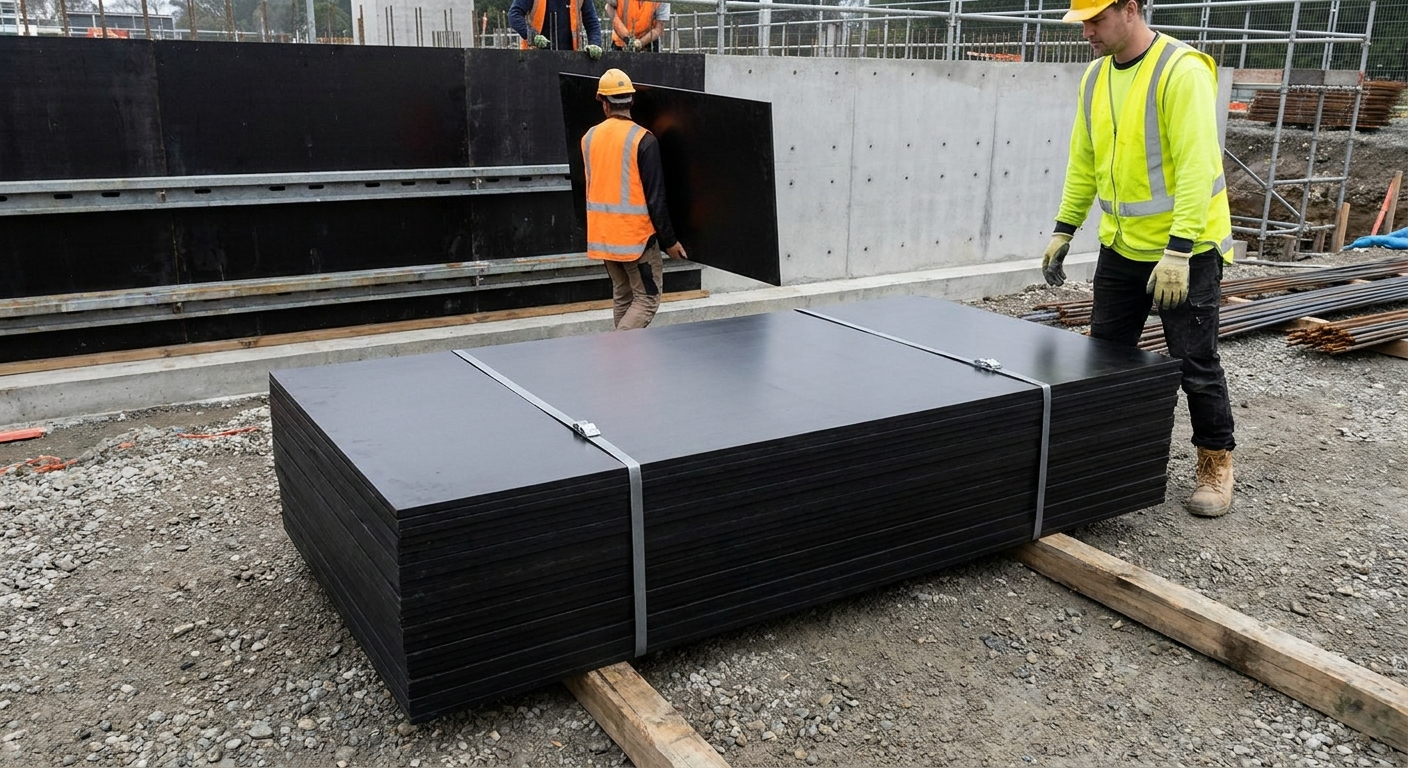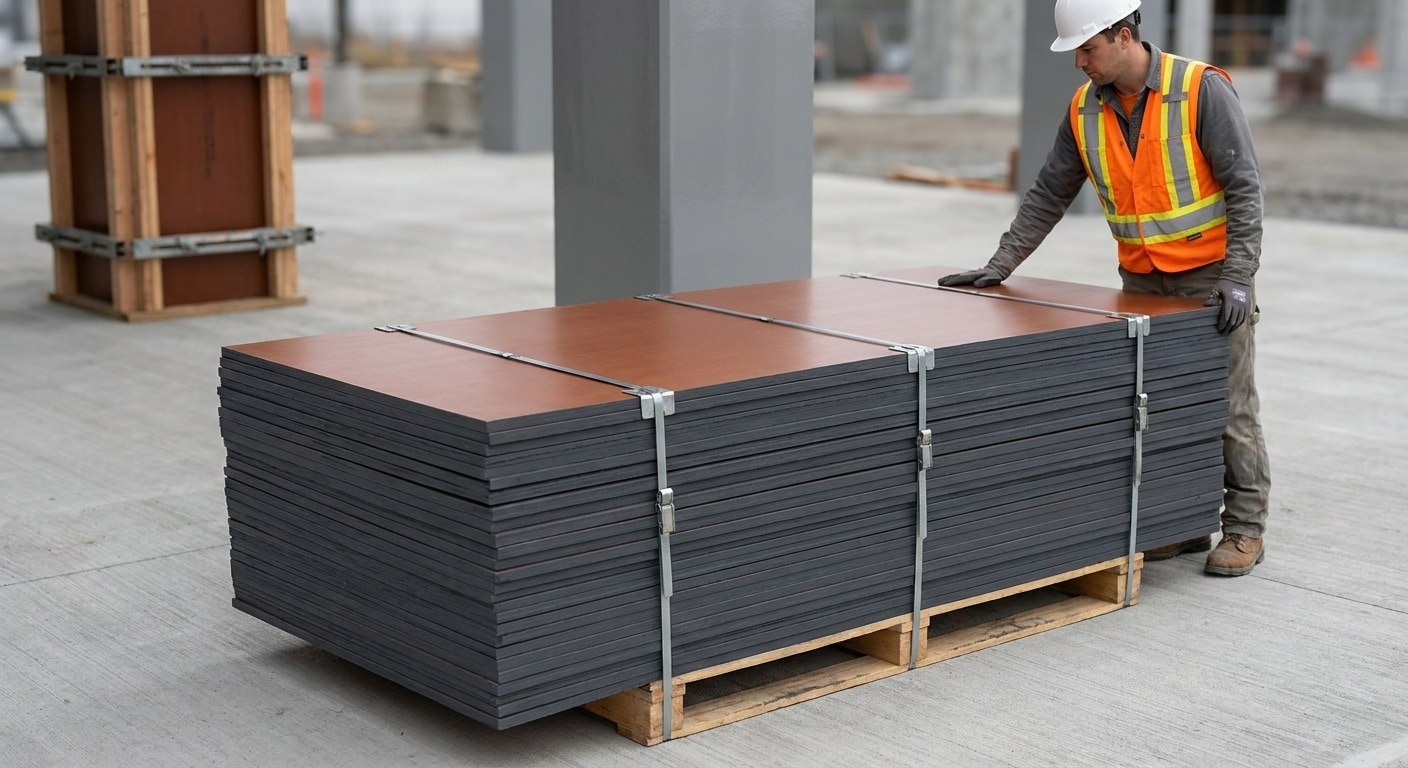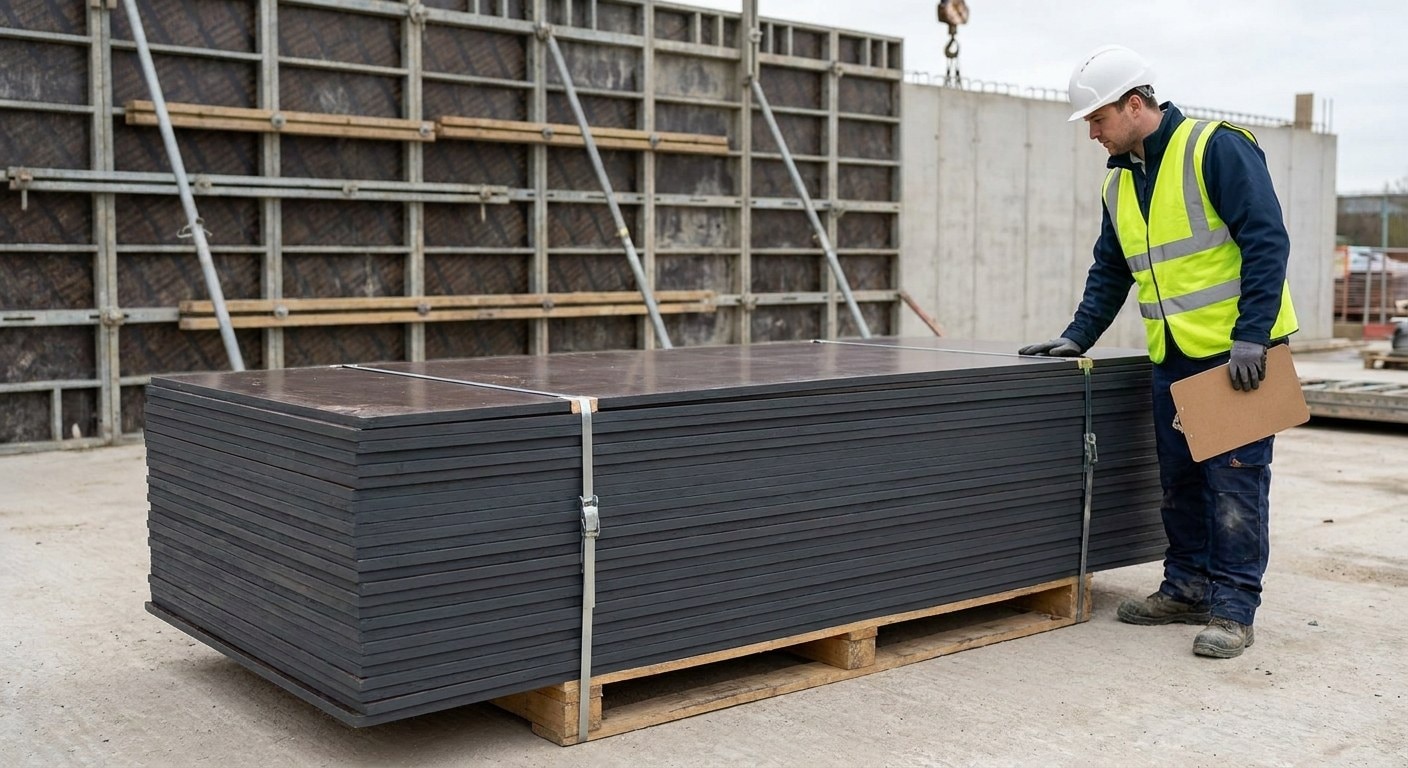
Plywood for Concrete Forms: Complete Contractor's Guide
What form plywood is, how plyform, HDO, MatteFace and film-faced panels compare for concrete forms, per-grade reuse and bond class, thickness and sheet sizes, and when a container from Vietnam beats yard stock on cost per pour.
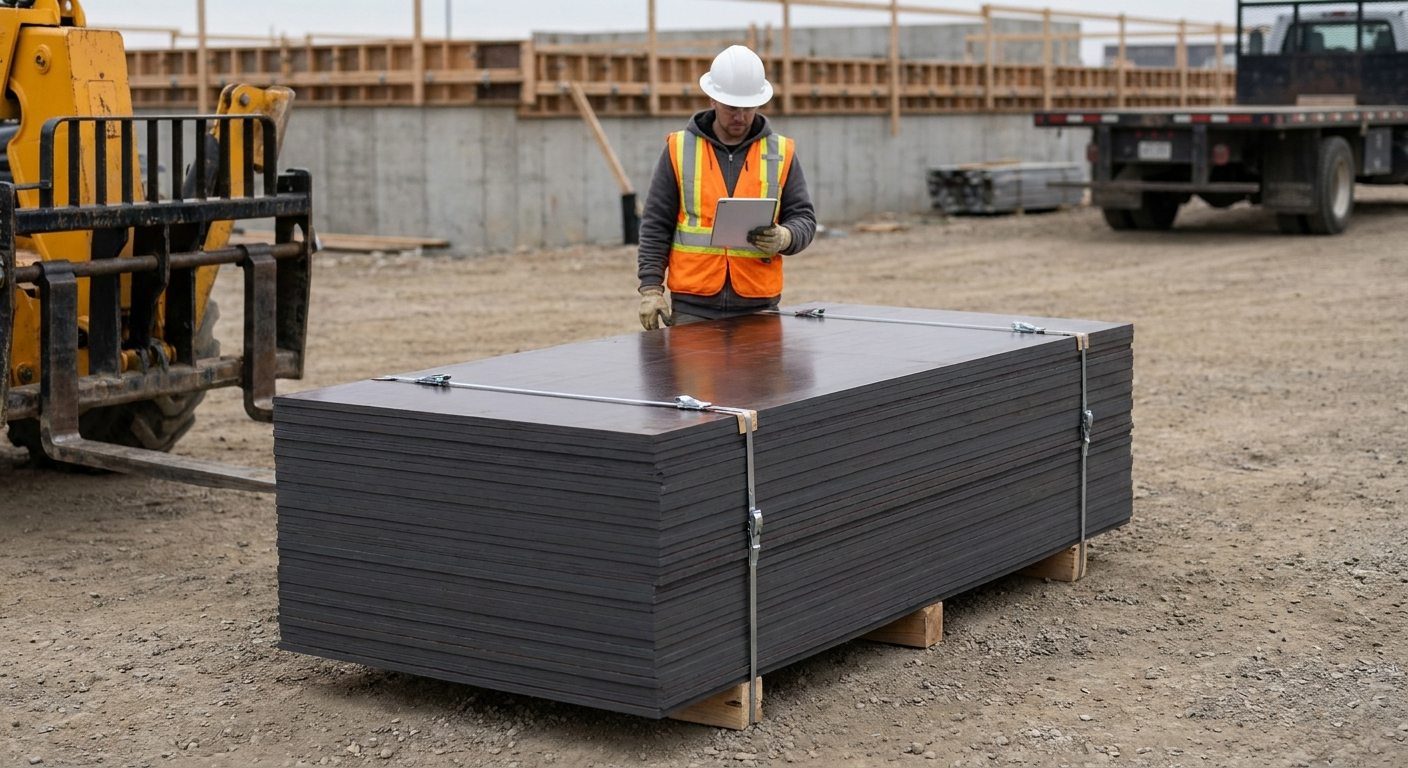
Form plywood is a panel built to hold wet concrete in shape and then strip clean so the crew can set it again. On North American jobs that usually means one of three things: APA plyform, a sanded B-grade panel sold from yard stock; an overlaid panel such as HDO, or MatteFace Plywood (MTF) for crews who search for MDO; or phenolic film-faced plywood, which is what most of the world means by form ply. The choice comes down to the face you need on the concrete, the bond class of the glue in the core, and how many pours you expect before the sheet is retired.
That is why plywood for concrete forms is bought on cost per pour rather than on the sheet price at the yard. The panel takes the fluid pressure of the mix, holds the finish the architect will look at, and has to release without tearing so the gang can move on. A sheet that bows between studs after two pours costs more in the end than one that comes back flat for fifteen.
A few terms will keep coming up, so here they are in plain words. Film-faced means a resin-impregnated paper film hot-pressed onto the face, and on our forming grades that film is phenolic. MDO is an APA overlay class that many buyers still type into search; the matte forming face we make is sold as MatteFace Plywood (MTF), and that is the name on the order. P-Form is a polypropylene overlay, a different product from Pro Form. Consply is commercial Bintangor face stock and is not a film-faced forming panel at all. The concrete forming plywood hub covers overlay chemistry in depth, so this guide sticks to sizing and buying.
What makes plywood suitable for concrete forms?
Wet concrete pushes on the form face like a liquid, and it keeps pushing until it starts to set. A sheathing panel that drinks mix water, delaminates at the glue line or bows between studs will print every one of those faults into the wall. Forming plywood is built for that load, and four properties decide whether it copes.
The first is the glue bond. A forming panel needs a WBP (weather and boil proof) bond, which means the glue line stays water-resistant after boil and soak tests. Depending on the grade, the core resin is phenolic (PF) or melamine-urea-formaldehyde (MUF), and both are a long way from the interior urea glues that fail when wet concrete sits against them for a day. The second is stiffness: a dense core with even veneer thickness resists deflection between studs and walers under the full fluid head, so the wall comes out straight. The third is the face. A film or overlay that is smooth and sealed gives a clean concrete surface, while a patched or rough face transfers every flaw.
The fourth property is the one crews forget, which is the edge. Moisture gets into a panel through its cut edges far faster than through the face, so a good forming panel leaves the mill with sealed edges and gets resealed after every saw cut on site. We see this in returned material more than anything else. The glue line is sound and the corners have swollen because nobody painted the cut. If the bond class itself is the open question on your project, our guide to WBP plywood is worth reading before the RFQ goes out.
Types of plywood used for concrete forms
Concrete form plywood comes in four broad families, and the difference between them sits mostly in the face. Sanded plyform leaves a light grain texture and lasts a handful of pours, while overlaid HDO and MatteFace or phenolic film-faced panels give a sealed face that comes back many more times. Price per sheet and pours per panel pull in opposite directions, which is the whole reason buyers compare them. The grade table below puts our reuse figures from product data side by side, assuming decent site practice.
BB/OES plyform (Class I and Class II)
Plyform is the APA-rated baseline that most US lumber yards keep in stock. Class I uses Group 1 species for the stiffest panel, while Class II allows Group 2 or 3 species, and both come with a sanded B-grade face and an oiled, edge-sealed (OES) finish from the mill. It is easy to buy in small lots, and a careful crew gets a handful of pours before the grain starts to show. We do not make it, but it is the panel our film-faced grades get compared with on most North American takeoffs.
MDO search term and MatteFace Plywood
MDO (medium density overlay) is the APA label for a resin-impregnated fibre overlay, and the full definition sits on our what is MDO plywood page. We do not sell a product called MDO. Our matte forming panel is MatteFace Plywood (MTF), a matte phenolic face for formwork only, and that is usually what buyers searching MDO for forming want.
The MatteFace builds are not all the same class, so it pays to name the panel. MatteFace Panel 1S, Panel 2S, 1SF and HD 1SF use a WBP phenolic core and carry the EN 636-3 Class 3 rating. MatteFace Eco 1SF uses a different core glue and sits in Class 2, with reuse of up to 6. Reuse on the Class 3 builds runs from up to 15 to up to 25 on Panel 2S, which is matte on both faces. The film-faced vs MDO vs HDO comparison sets the overlays against each other, and the MatteFace collection lists the sizes.
HDO plyform
HDO (high density overlay) uses a denser, resin-rich overlay that gives a hard face able to take abrasion from vibrators and scrapers. In the US it is the usual choice for gang forms that get set again and again. We press HDO in three grades, and they split across the bond classes. HDO Basic is a Class 2 panel rated for up to 10 reuses, while HDO Standard and HDO Premium use a WBP phenolic core at Class 3 and run up to 20, with Premium overlaid on both faces. The HDO plywood collection has the full specifications.
Film-faced phenolic grades
Film-faced plywood carries a phenolic film on both faces and dominates forming outside North America because it gives a sealed, even surface at a sensible price. Its life depends on film weight and core resin. When a quote simply says melamine, ask which of three things it means, because the core resin (MUF), the chemistry of the face film and a decorative furniture laminate are not interchangeable on a pour programme.
Our film-faced ladder runs on a plantation-grown hardwood core and climbs in two steps. Eco Form, Eco Form Plus, Form Basic and Form Extra all carry a 165 g/m² phenolic film over an MUF core at EN 636-2 Class 2, and reuse rises from up to 6 to up to 15 as the core glue improves; Form Extra uses the stronger WBP Melamine Top glue, so its extra life comes from the bond rather than a heavier film. Pro Form Lite and Pro Form switch to a WBP phenolic core at EN 636-3 Class 3, and Pro Form adds a 125 g/m² top-grade film for up to 20 pours. The film-faced plywood collection shows sizes and face patterns.
Grade table: forming plywood side by side
| Panel | Face | Bond class | Reuse (product data) | Concrete finish |
|---|---|---|---|---|
| BB/OES plyform | Sanded veneer | APA exterior | a handful of pours (yard stock) | Fair, some grain transfer |
| Eco Form | Phenolic film 165 g/m² | MUF, EN 636-2 Class 2 | up to 6 | Smooth, sealed |
| Eco Form Plus | Phenolic film 165 g/m² | MUF, EN 636-2 Class 2 | up to 8 | Smooth, sealed |
| Form Basic | Phenolic film 165 g/m² | MUF, EN 636-2 Class 2 | up to 10 | Smooth, sealed |
| Form Extra | Phenolic film 165 g/m² | WBP Melamine Top, EN 636-2 Class 2 | up to 15 | Smooth, sealed |
| Pro Form Lite | Phenolic film 165 g/m² | WBP phenolic, EN 636-3 Class 3 | up to 15 | Smooth, sealed |
| Pro Form | Phenolic film 125 g/m² top grade | WBP phenolic, EN 636-3 Class 3 | up to 20 | Smooth, sealed |
| HDO Basic | HDO Basic coating | Class 2 | up to 10 | Near-gloss |
| HDO Standard | HDO coating, one face | WBP phenolic, Class 3 | up to 20 | Near-gloss |
| HDO Premium | HDO coating, both faces | WBP phenolic, Class 3 | up to 20 | Near-gloss |
| MatteFace Panel 1S / 1SF | Matte phenolic | WBP phenolic, Class 3 | up to 15 | Smooth matte |
| MatteFace HD 1SF | Matte phenolic | WBP phenolic, Class 3 | up to 17 | Smooth matte |
| MatteFace Panel 2S | Matte phenolic, both faces | WBP phenolic, Class 3 | up to 25 | Smooth matte |
| MatteFace Eco 1SF | Matte phenolic | Class 2 | up to 6 | Smooth matte |
Can you use regular plywood for concrete forms?
You can, once, and the result usually shows it. Regular CDX sheathing has C and D grade veneers with open knots and a rough face, and its glue is rated for exterior or Exposure 1 conditions during construction rather than for days of contact with wet concrete. The face soaks up mix water and prints its knots into the wall, which nobody minds on a one-off footing that gets backfilled.
The trouble starts when the sheet is expected to come back. Form plywood is pressed with a sealed face and a bond that tolerates repeated wetting, so a crew can clean it, oil it and set it again without the face lifting. CDX was never designed for that, so its cost per pour climbs fast after the first use. For anything that needs a clean finish or more than a couple of cycles, specify plyform, HDO, MatteFace or a film-faced form panel.
Plywood thickness for concrete forms
Thickness sets how much load a sheet can carry between supports, and getting it wrong shows up as a bulging wall. On North American wall forms, 18 mm (3/4 inch) handles most wall and foundation pours with studs 12 to 16 inches on center for walls up to roughly 8 feet, which is 300 to 400 mm centres in metric. A 15 mm (5/8 inch) sheet is for curbs, short stem walls and low pours only. Heavy foundation walls, deep beams and high fluid head move up to 25 mm (1 inch) or 28 mm (1-1/8 inch), especially where studs are spaced wider. The full support map is in the concrete formwork plywood thickness guide.
Standard plywood sizes for concrete forming
In North America the standard sheet is 1220 × 2440 mm, or 4 × 8 feet, which suits lumber-framed forms and wastes little on 8-foot walls, while European stock and many international film-faced lines run 1250 × 2500 mm. Modular systems from Doka, Peri, Alsina and others often need a system blank, and on container-quantity RFQs we can cut to order. Map the pour before you buy, because every rip you avoid is one less edge to seal.
How to choose the right plywood for your project
The finish the concrete needs and the number of times the panel must come back drive the match, with site handling and budget close behind. The table pairs common project types with grades and per-grade reuse.
| Project type | Finish | Reuse expected | Grades to look at |
|---|---|---|---|
| Residential foundation | Structural, below grade | a few pours | BB/OES yard stock; Eco Form Plus (up to 8); Form Basic (up to 10) |
| Commercial walls | Smooth, little patching | medium | HDO Basic (up to 10); Form Extra (up to 15); MatteFace 1SF (up to 15) |
| Architectural, fair-face | Near-perfect | medium to high | Pro Form Lite (up to 15); Pro Form (up to 20); HDO Premium (up to 20) |
| High-cycle commercial | Consistent over many pours | high | Pro Form (up to 20); HDO Standard or Premium (up to 20); MatteFace Panel 2S (up to 25) |
| Humid or wet sites | Any | Any | A sealed film-faced or overlaid panel with a WBP bond and a plantation-grown core |
For most US crews on residential and light commercial work, HDO or MatteFace strikes the balance between finish and reuse. For container-scale commercial programmes, film-faced Pro Form or Pro Form Lite shipped from Vietnam is usually where the cost-per-pour conversation ends up, and our sales team can price it against your takeoff.
Form accessories that decide panel life
The sheet is only one part of the form, and the hardware around it decides whether the face survives to the next pour. Ties hold opposing walls at spacing under pressure, and clean drilling stops the face splitting around each hole, while walers and studs carry the load back to the ties at a spacing matched to thickness and pour height. Release agent needs a thin coat before every pour, because without it cement paste bonds to the face and tears the film at stripping; use a commercial form oil, never motor oil or diesel. Edge sealer matters most, since an unsealed cut is the fastest route for water into the core. Our panels leave the mill with sealed edges and still need resealing after every site cut.
How to extend forming plywood life
Most panel life is won or lost in the first hour after stripping. Clean the face straight away with a plastic scraper and rinse it while the residue is still green, because a steel blade will cut the film and every later pour will find the scratch. Put release agent on before every pour, new panels included, and reseal each edge after a site cut.
Storage is the other half: flat, off the ground, under cover, with bearers under the stack. Small gouges and film tears can be patched with epoxy filler, which beats retiring a sheet. We have looked at returned pallets where the glue line was perfectly sound and the film was shredded at the corners. That was a site problem rather than a mill problem, and in our experience it nearly always traces back to the edges and the scraper.
Domestic plyform vs imported film-faced: cost per pour
The real cost of a form panel is its cost per pour once reuse, freight and handling are counted, and because resin, veneer and ocean freight all move, we quote against your programme rather than publishing a price list that would be stale within a month.
Domestic yard stock wins on speed and small lots. Buying direct from a mill in Vietnam wins when the takeoff fills a container and the bond class is written into the order. Lead times follow vessels and inspection slots, so plan the pour date with our sales team early.
We have made plywood in Vietnam since 1992 and ship about 5,000 containers a year to more than 55 countries, with every sheet inspected individually before packing. Our cores are plantation-grown Acacia, Eucalyptus or Hevea with WBP glue systems, and FSC-COC material is available when a project asks for it. For North American distributors who need ready stock between containers, Vinawood keeps distribution warehouses in Toronto, Vancouver, Calgary, Montreal, Miami, Houston and Baltimore to supply local distributors.
When you are ready, send the pour programme and the grade you have in mind through /rfq or the quotation form. Put thickness, size, grade, bond class, expected reuse and discharge port in the same message. The lot is accepted on the declaration of performance and the mill test report, not on a colour photo of the film.
Category
guides